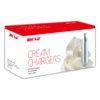
Just how to Shop and Take Care Of Nitrous Oxide Cream Chargers Properly
If you function a pastry terminal on a Saturday night or run a small café where every coffee obtains a crown of chantilly, you currently recognize that consistency is everything. The body of the lotion, the rigidity of the bubbles, the tidy breeze of a stainless head when you purge the cylinder. None of that takes place by mishap. It starts with the method you keep and manage your lotion chargers.
Nitrous oxide is a flexible gas in service and an unrelenting one in storage. Treat it delicately and you obtain irregular appearance, stuck shutoffs, frostbite nicks on your fingers, or in the most awful situation a burst cartridge. Regard it and you obtain quick, stable whipped cream with predictable returns, week after week. The difference is in the details, and the information are not made complex, yet they are non‑negotiable.
What cream chargers are, and why their handling matters
Cream chargers, likewise called whipped cream chargers, are small steel cartridges loaded with food‑grade nitrous oxide. Most are 8 grams of N2O per cartridge, however 16 gram cartridges exist, and bigger refillable cyndrical tubes are making their method into busy shops. They are created to puncture and release right into a compatible lotion whipper, where the gas dissolves right into the fat phase of the lotion. Agitation and stress force microbubbles to develop and stabilize, which gives you the structure you want on the plate.
Nitrous oxide is not inert to mishandling. It is a pressed gas with a high vapor pressure and a pronounced Joule‑Thomson cooling effect when increased. Translation: when you vent it promptly, surfaces get very cool. Steel at reduced temperature level can attack skin. The pressurized cartridge ends up being a projectile if heated up or penetrated poorly. Oil or oil on seals can swell and stop working. All of those risks are very easy to control if you keep and handle the battery chargers correctly.
The setting your chargers want
Aim for amazing, dry, and dark. 3 straightforward adjectives, however each has consequences.
Cool implies area temperature level or a bit reduced. The pleasant area is approximately 15 to 25 levels Celsius, 59 to 77 Fahrenheit. At that range, vapor pressure stays in a risk-free band, the inner seals in your dispenser last much longer, and you stay clear of thermal biking that emphasizes welds and crimps. I have seen boxes left near a pizza oven reach 35 C on a Friday thrill. The following early morning we had 2 cartridges with protruded joints and a loud hiss when moved. They went straight to waste. That was a pricey lesson.
Dry implies no condensation, no roofing leakages, no wet cellar shelves. Steel is steel. Despite having a zinc covering, lengthy exposure to dampness will certainly lead to surface area corrosion. Small flowering does not always indicate failing, but rust compromises stamina and can flake right into your leak area, which takes the chance of a leaky seal ahead of the whipper. I once enjoyed a younger cook drink a canister and hear what he thought was "sand." It was deterioration inside a box of affordable chargers saved on a bare concrete floor after a wipe spill. That box went out the door.
Dark is much less about UV reacting with nitrous oxide, which is reduced risk, and a lot more concerning temperature stability. Sunshine warms secured boxes unevenly. If your storage space rack has a home window, placed battery chargers on a lower degree or make use of nontransparent bins.
You do not need refrigeration for chargers, and you must prevent it. The gas resides in a liquid‑gas stability inside the cartridge. Trendy conditions are great, yet moving them from a refrigerator to a warm line continuously creates condensation on the steel, then rust. The dispensers take advantage of chilly lotion. The cartridges do not.
Packaging, turning, and what to keep or toss
The cartridge itself is a sealed pressure vessel. If the box remains undamaged, they can sit for years. That stated, I note every situation with the day it got here and revolve. First in, initially out jobs fine. If you break open an instance, maintain continuing to be sleeves in a lidded plastic carry to regulate moisture and dust. Do not dump loose battery chargers into a drawer. That is the fastest course to dings, grit on the puncturing end, and mystery cross‑brand mixing that perplexes your personnel training and troubleshooting.
Watch for these flaws when you open a sleeve: nicked bodies, curved necks, corrosion spots bigger than a pinhead, oily deposit near the seal, or a cartridge that feels much lighter than the rest. Those enter the decline bin. If greater than one in a sleeve looks suspicious, pull the entire sleeve from solution and talk with the vendor. Over a decade, my appropriate deny rate is under one per thousand. Anything higher suggests a set or transport problem.
Brand issues, and except vanity. Food‑grade nitrous oxide is not all equal. Respectable suppliers tidy and filter their gas and keep tight tolerances on the amount of propellant. Cheap imports can carry trace impurities that contribute to off flavors and inconsistent foam. If your whipped cream tastes slightly sweet‑chemical or your siphon gums up with sticky deposit after a week, switch brands. Saving a couple of cents per cartridge is not a win if it costs you a pastry return before the pass.
Temperature, pressure, and what they do to performance
Nitrous oxide's vapor pressure approximately doubles between 0 C and 30 C. That stress curve has straight effects on both security and structure. At greater temperatures, the cartridge pressure rises. In a sealed dispenser, you will certainly see even more strenuous discharge and a more powerful blast when airing vent. That can tear lotion, create large bubbles, and cause a soupy head as the structure collapses. At reduced temperature levels, stress drops and gas circulation is slow-moving. You end up over‑shaking to make up, which produces butter streaks and dense patches.
If you have ever had a whipper spit watery cream for the very first few pulls, after that settle, you have actually really felt temperature level inequality at the workplace. The gas is as well warm, the cream is cool, and the initial development is violent. Store battery chargers at ambient and let the lotion be the cool aspect. If your cooking area runs warm, keep the chargers in a different room or in a cooled down drawer far from ovens and dish washers. I have seen a bread group move their chargers throughout the line by practice and wreck a day's solution in July with over‑pressurized initial pulls. We fixed it with a four‑dollar thermometer on the storage bin and a guideline: if it checks out above 25 C, move the bin.
Handling throughout solution: the rhythm that protects gear and product
The choreography matters. Take the dispenser body, verify the gasket is seated and tidy, add cool lotion and any kind of sugar or stabilizers, after that string on the head hand‑tight. Place the charger in the holder, straighten it with the puncturing pin, and screw down up until you hear the gas rush in. That noise needs to be sharp and quick, not a prolonged hiss. Shake five to 8 times with a firm wrist. Remove a little test squirt right into a waste cup. Change shaking by one or two shakes if the structure is off. After that keep the whipper upside down in the fridge or an ice bath on the line.
Never thread the charger at an angle, and never ever cross‑thread the owner. Replacing a head is costly. Changing a charger owner is cheaper, but avoidable. If an owner obtains stuck after discharge, do not force it with pliers while the dispenser is pressurized. Vent the dispenser first, after that attempt once again. Grease is not your good friend below. A light wipe of a food‑safe silicone on the holder threads as soon as a month is enough.
If you double‑charge a one‑pint dispenser, do it deliberately. Several chefs do, and on specific formulas it helps. But make certain the equipment is rated for it, and make certain you have the headspace. Never fill a second charger right into a dispenser that is slow-moving to vent or has a stopped up suggestion. You will not bypass the blockage with more stress, you will certainly create a dangerous bundle. Vent, clean, inspect the gasket and the valve springtime, after that proceed.
House regulations that stop accidents
Every shop needs specific standards, specifically for brand-new staff that might have used battery chargers at home without a framework. Here is the backbone I make use of to train a team.

- Store unopened cream chargers in a trendy, dry, shaded area, off the floor, in their original sleeves inside a lidded container. Mark the container with arrival day and rotate.
- Inspect each sleeve as you open it. Pull any type of cartridge with damages, rust, oil, or noticeable problems. If you find more than one in a sleeve, quarantine the sleeve and inform a supervisor.
- Load just on a steady, dry surface. Keep hands clear of the piercing area. Do not make use of devices to tighten the charger holder. Hand‑tight only.
- Never warm a cream dispenser to speed up solution. If cozy sauce foams become part of the menu, make use of a bain‑marie under 70 C and adhere to the producer's temperature ceiling.
- At end of service, air vent the dispenser totally before unscrewing parts. Wash instantly with warm water, dismantle, and allow every element completely dry prior to reassembly.
Those 5 rules stop 95 percent of the concerns I have actually seen. The continuing to be 5 percent come from the edge instances and be entitled to focus too.
Edge cases, and just how to think them through
Transport can be challenging. If you provide off‑site and drive with situations of N2O cream chargers, treat them as you would white wine or delicious chocolate in summertime. Do not leave them in a closed auto under sunshine. Trunk temperature levels can climb past 60 C within mins. That is a severe security risk. Maintain them in the air‑conditioned cabin, and never load them alongside solidified carbon dioxide. Severe cold is not as dangerous as heat, but it presents condensation and slipping hazards.
Altitude shifts your standard. At high altitude, atmospheric pressure is reduced, so the differential between inner and outside stress expands. Chargers feature, yet your dispenser may launch a lot more aggressively than you expect. In Aspen I call down drinking by 2 beats and see the very first pull closely.
Oil and fat deposits damage seals. Maintain the piercing location and the threads clean, and maintain aerosol oils away. I have actually seen enthusiastic prep chefs spray a coat of pan launch on the dispenser head "to make it easier to clean." It swelled the gasket and transformed a $40 component into trash. A moderate meal soap, warm water, a container brush, and a towel are all you need.
Long breaks issue. If the whipper rests for hours, the foam can divide. Stabilizers like gelatin, agar, or business blends assist with warm sauces and long holding times, but they include their own handling needs. Gelatin wants mindful flowering and unification; agar wants a boil. If your formula includes alcohol, expect lower return and softer structure. Alcohol alters the gas solubility and the foam security. Adjust by decreasing included liquid or enhancing fat content, not by jamming in an extra charger.
Cleaning, maintenance, and when to retire equipment
Most issues that appear like bad gas become devices concerns. After every service, air vent totally. Loosen the pointer and pull the valve out. Rinse every component in cozy, not hot, water. Check the tiny O‑ring on the shutoff stem. If it fractures or looks flattened, change it. A substitute set prices little and saves you hours of pain. Dry completely. Trapped water in the head can adhere the shutoff at the next charge and develop a short-lived blockage that feels like a failed cartridge.
Every week, do a deeper check. Look at the seat where the cartridge owner fulfills the head. If it shows gouges, burrs, or smudged rings, you have mini leaks. A new owner might resolve it. Otherwise, the head needs retirement. Stainless bodies last for several years; light weight aluminum heads have a finite life in hefty solution. When doubtful, decommission and replace. No plated dessert is worth a projectile.
If your group utilizes numerous brand names of whipped cream chargers as a result of provide chain, tag the owners. A couple of brands have refined dimensional distinctions. Mixing an owner that is developed for a somewhat much shorter cartridge with a much longer one can overstress the string and the piercing pin. That is unusual but real.
The role of brand and certification
With food‑contact products, accreditation matters. Seek battery chargers that define food‑grade laughing gas and checklist conformity with acknowledged standards where you are running. A healthiness of gas purity decreases off tastes and decreases the risk of contaminant residues in the shutoff. If you are buying at volume, ask your distributor for set traceability. The very best vendors can tell you which lot mosted likely to your shop and when. That liability comes to be important if you ever before require to audit a failure.
As for refillable cyndrical tubes, they are effective for high volume and lower waste, yet they require their very own handling protocol. Cylinders need to be secured upright, covered when not linked, and kept far from heat. Regulatory authorities need to match the cyndrical tube type, and connections require to be tight however not torqued to death. Train the group on airing vent lines prior to separating. A blast of chilly gas from a loosened installation will numb fingers and startle a chef right into dropping a cyndrical tube. I have actually seen it happen. No injuries, plenty of swearing, and a brand-new rule taped to the wall.
Legal and ethical considerations
Nitrous oxide has non‑culinary usages, which reality shows up in guidelines and supply plans. Maintain your inventory regulated. If you operate a bar or a place with open accessibility storage, secure the battery chargers. Track use by sleeve on a white boards near the bread cooler. When devices go missing in a pattern, investigate. I favor to treat it as a security issue, not an ethical panic. A clear policy and consistent practice maintain you on the ideal side of local guidelines and shield your team.
Disposal is basic, but not a free‑for‑all. Used battery chargers are steel and can be recycled. Numerous districts ask that you confirm they are vacant. In practice, that means a visible slit or kink mark and a fast shake to verify no fluid sloshing inside. Maintain an identified bin for empties away from the line. Do not crush them with a boot or a bar press. That is theatre, not safety.
Product uniformity: constructing a repeatable process
Storage and handling feed directly right into home plate. If your chantilly varies day to day, check out the entire chain. Lotion fat percent, sugar choice, stabilizer use, and solution temperature are the foreground variables. Gas cost, cartridge condition, and dispenser upkeep are the background ones that sneak up on you. Establish a requirement: 35 percent fat lotion, cooled overnight, white sugar or superfine as defined, optional 0.2 to 0.4 percent jelly flower for long holds, one battery charger for a half‑liter, 2 for a litre, drink 7 times. Write it, educate it, investigate it. When you require to depart, you will certainly recognize why and by just how much.
The very same thinking aids when you utilize your dispenser beyond cream. Espumas, sabayons, cocktail foams, and instilled oils each have their traits. Citrus curd foams can curdle if overheated; pea velouté foams desire a tamis pass to prevent obstructing; fat‑rich sauces can separate under warm lights. Start with careful purification, respect optimum temperatures, and examination little sets. If you blow a shutoff with a seeded berry espuma, you will remember it forever.
Anecdotes from the line: what failure looks like
The loudest pop I ever learnt through a charger was during a breakfast crush. A box had actually been provided and put by the coffee roaster exhaust due to the fact that the receiver believed "completely dry rack space is dry rack room." That shelf hit 40 C on hectic early mornings. One cartridge protruded and blew its crimp inside the secured box, venting harmlessly however seeming like a snapped spatula on a steel table. We shut down the pastry terminal for 10 mins, relocated the stock, and mounted an inexpensive thermostat probe on that rack. No repeats.
The strangest taste I ever before pulled from a dispenser tasted like fabricated banana. It took a day to identify. The chargers were great. The trouble was a new preparation crew member cleaning the head with aromatic hand soap when the recipe pit backed up. Those aromas cling. Now we keep a specialized bottle of unscented dish soap with a "head just" label.
The messiest failure came from a double‑charged liter container with an aging gasket. The first pulls were best. Mid‑service, the head loosened up somewhat, gas tracked along the weakened seal, and the whole litre repainted the bottom of the shelf over the pastry pass. We cleaned up for an hour and replaced every gasket in inventory that afternoon.
What to do when something goes wrong
Even with ideal storage space, tools fails. If you listen to constant hissing after filling, stop. Air vent the dispenser outdoors or into a deep sink. Do not inspect a hissing head at close quarters. When vented, take apart, evaluate the valve seat and the puncturing pin, and change suspect components. If a battery charger feels odd on threading, withdraw. Do not compel steel on steel. Swap in a different sleeve. If the very same concern persists, the head is likely at fault.
If a staff member gets a cold shed from aired vent gas, run warm water over the area, not hot, and avoid massaging. Most are minor and settle swiftly. If you see sores or shade changes beyond a shallow frost mark, send them for medical assessment. Then evaluate the packing procedure with the team and look for leaks that might have motivated fingers to stray near the discharge path.
If a cartridge ruptures in storage, treat it as a close to miss. Record the location, the ambient temperature, the brand, and the lot code. Call the supplier. Move remaining supply to a cooler area. Take into consideration a temperature level logger in the area for a week. You will discover more from that data than from guesswork.
Final thoughts that make the habit stick
Good habits around N2O cream chargers are not regarding anxiety. They are about respect for a device that does a lot of work for us. Shop them cool, completely dry, and dark. Rotate attentively. Evaluate your gear. Train your team till the actions are muscular tissue memory. Select brands that stand behind their product. Take care of the line stress of solution without taking faster ways that invite failure. When something goes sidewards, slow down, vent, and diagnose.
I have actually collaborated with chefs that believed battery chargers were fussy little bullets, and with pastry chefs who treat them like scalpel‑precise tools. The chefs improve results. And when the regimen is called in, your whipped lotion, your foams, and your profits will all really feel the difference.
Remember the thing no one discuss: guests notice. A flawlessly rotated quenelle of chantilly that holds its form to the last bite is not a mishap. It is the result of the method you store your Laughing gas cream chargers, the way you fill them, and the self-control you bring to your station. Deal with the tiny steel cartridge with care, and it will make you look excellent on every plate.