
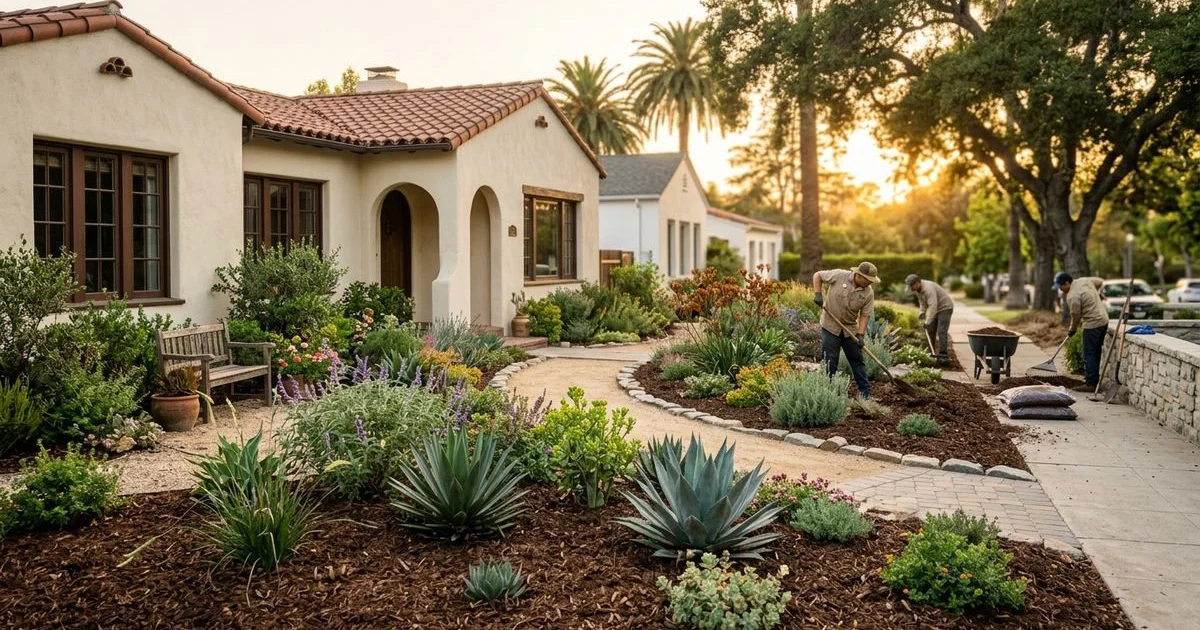
How to Build a Firewise Hillside Landscape
A hillside in the San Gabriel Valley asks for more than a pretty planting plan. It asks for restraint, structure, and a clear understanding of how slope, heat, wind, water, and vegetation work together. On flat ground, you can get away with improvisation. On a hillside, every choice has consequences. Water that runs too fast will carry soil with it. Plants that look lush for a season can become a maintenance problem if they need too much irrigation or create the kind of continuous fuel that fire can carry. A thoughtful hillside landscape has to solve for all of it at once.
That is especially true in the San Gabriel Valley, where the visual character of the hills is part of the place itself. New construction, retrofits, and garden renovations in these foothill settings increasingly need to balance drought-tolerant planting, erosion control, drainage, and firewise thinking. The good news is that these goals do not conflict as much as people assume. Done well, a hillside can be beautiful, water-conscious, and more resilient than the turf-heavy landscapes many properties inherited years ago.
Start with the hillside you actually have
The first mistake I see is people designing for the slope they wish they had, not the one under their feet. A hillside is not one condition, it is a series of microclimates. The top of the slope may be hotter and drier than the lower section. One side may get brutal sun from late morning through the afternoon. Another may stay in shade long enough to change what will thrive there. Soil can also shift across the property, and that matters because water moves differently on a slope than it does on level ground.
California water guidance makes the right starting point clear, assess irrigation, soil, sun exposure, and plant selection before removing turf. That sequence matters. Turf removal is often the visible goal, but if you do it before understanding drainage and water delivery, you can create more problems than you solve. A hillside landscape should begin with a simple question: where does water want to go when it lands here? If you ignore that, even a good plant palette will struggle.
On a slope, I also look at where runoff is already cutting channels or pooling near hard edges. Those clues tell you where erosion control needs to come first. In some cases, the landscape needs small grading adjustments, not dramatic reshaping, but just enough to slow water and let the soil absorb it instead of sending it downhill.
Firewise and water-wise belong in the same conversation
Firewise planning is often discussed as if it is only about what not to plant, but that view is too narrow. A firewise hillside landscape is really about how the whole site behaves under stress. The arrangement of plants, the spacing between them, the use of hardscape, and the way irrigation is managed all influence how vulnerable the property is.
That is why drought resistant landscaping and firewise design often reinforce each other. Plants that are adapted to local climate conditions usually need less supplemental water once established. They are less likely to grow into dense, thirsty masses that require constant pruning. California’s statewide Model Water Efficient Landscape Ordinance also pushes design in this direction, especially for new and renovated landscapes. It encourages native and climate-appropriate plants, efficient irrigation, and alternative water sources where appropriate. In practical terms, that means the landscape should not be built around plants that need weekly coddling on a hillside exposed to sun, wind, and summer heat.
The California Native Plant Society has also emphasized that slopes need erosion control, drought tolerance, and firewise planting. That combination fits San Gabriel Valley hillside properties especially well. If you choose plants only for their appearance in spring bloom, you may end up with a landscape that is beautiful but fragile. If you choose them for their ability to hold soil, live with less water, and avoid creating a continuous ladder of fuel, you get something far more durable.
Hardscaping should do real work
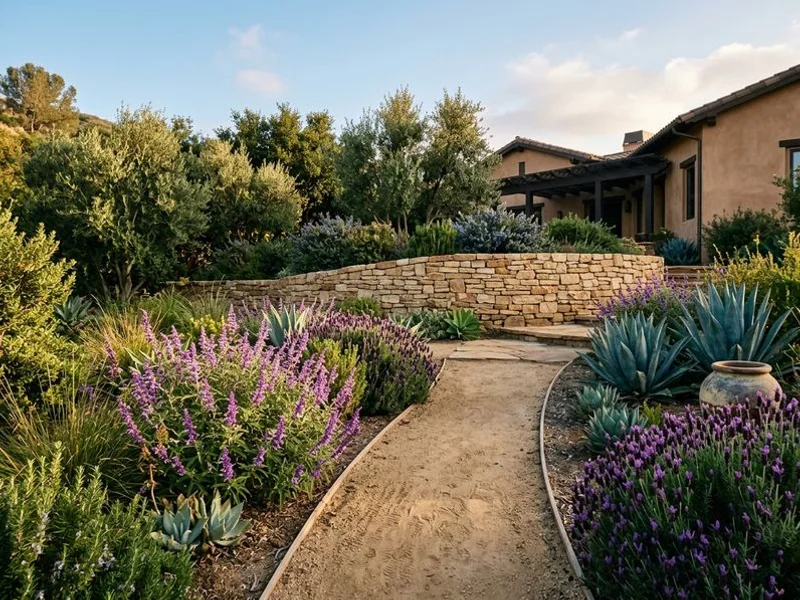
Good hardscaping on a hillside is not decorative filler. It is infrastructure. Retaining walls, paths, steps, terraces, and rock features can help break a steep site into manageable zones, reduce erosion, and create access for maintenance. They can also serve as natural separators between planting areas, which is useful in a firewise design because you do not want one uninterrupted mass of combustible material climbing the slope.
That said, hardscaping has to be used with discipline. Too much can make a hillside look overbuilt and sterile. Too little leaves the slope vulnerable and hard to maintain. The best hillside landscapes usually rely on a restrained mix of structures that support the planting design rather than compete with it. A narrow decomposed granite path, a modest terrace, or a low retaining element can do more useful work than an elaborate arrangement of decorative features.
I have seen properties where a single well-placed terrace turned an awkward hillside into a landscape that could actually be maintained by the owner. That matters because the best design on paper is useless if nobody can safely get to the plants, check the irrigation, or remove debris after windy weather. A firewise hillside landscape should be designed for access as much as for appearance.
Choose plants for slope stability, not just style
Plant selection on landscapers Pasadena CA a hillside should be guided by function first. The right plants help slow runoff, hold soil, and create a layered landscape that does not feel monotonous. In the San Gabriel Valley, local and climate-appropriate plants are especially practical because they align with water conservation goals and can fit the area’s hillside conditions.
California buckwheat, California sagebrush, manzanita, ceanothus, monkeyflower, foothill penstemon, and bunchgrasses are all examples of plants that naturally fit the region. San Gabriel oak is also a locally named native species that belongs in the broader conversation about native habitat gardening. These plants are not interchangeable, and they do not all want the same exposure or moisture, but they share an important trait. They make sense in a California hillside system where drought tolerance and local adaptation matter.
The point is not to build a museum of native plants. The point is to use them where they solve landscape problems. Bunchgrasses can help knit soil together. Low shrubs can break visual and physical continuity. Flowering species can add seasonal interest without requiring a heavy irrigation load. On a hillside, that kind of plant community is more useful than a broad carpet of thirstier ornamentals.
Respect defensible space without stripping the landscape bare
Firewise landscaping sometimes gets flattened into one oversimplified idea: remove everything green close to the house. That is not the whole picture. The San Gabriel Mountains region is home to many rare, threatened, and endangered species, and local native planting has real ecological value. The goal is not to erase vegetation. The goal is to arrange it intelligently.
Defensible space means paying attention to what grows closest to structures, how plants are spaced, and whether maintenance can keep dead material from building up. It also means avoiding dense, unbroken plant masses that can carry fire readily. You want separation, variation, and visibility. You want to be able to see the ground in places, especially near structures and along access routes. You want to avoid piling mulch, debris, or overgrown branches where they can create a hidden fuel load.
A useful way to think about it is this: the landscape should not invite fire to travel uphill in a continuous path. Hardscape can interrupt that path. Open space can interrupt it. Lower-growing plants can interrupt it. A hillside that has a mix of textures and clear separations is usually more manageable than one with a single dense planting scheme.
Irrigation has to match the slope
Hillside irrigation is one of those things that seems straightforward until you watch it fail. Water applied too quickly will run off before roots can use it. Overwatering can destabilize the slope and waste a lot of water. Uneven distribution can leave one section soggy and another section stressed, which is a recipe for patchy growth and weak establishment.
A better approach is usually efficient irrigation tailored to the planting zones. California’s landscape guidance encourages looking at plant water needs through resources such as WUCOLS, which helps match plants to region-appropriate water use. That matters on a hillside because one plant may do fine with very little supplemental water once established, while another may need a different schedule during establishment. If you treat them all the same, some will suffer and others will be overwatered.
When a property is transitioning away from turf, irrigation retrofits deserve as much attention as the plant palette. Turf systems are not always suited to shrubs and perennials on a slope. Drip irrigation, properly zoned and adjusted, often gives much better control. On some sites, the better solution is to reduce irrigated area overall and rely more heavily on plants that can live with less. That approach aligns with drought resistant landscaping and helps keep maintenance more predictable.
Turf removal works best when it is planned, not rushed
Turf removal gets a lot of attention because it is visible and immediate, but it should never be treated as a standalone solution. California guidance is clear that you should assess the site before removing turf. On a hillside, that advice is even more important. If you remove turf without replacing its erosion control function, you may leave bare soil exposed to runoff and wind. If you remove it without considering irrigation changes, you may end up wasting water on plants that cannot use it efficiently.
The best turf conversions I have seen are staged. The site is evaluated first, then irrigation is adjusted, then slope stabilization is addressed, and only then is the planting installed. This may feel slower than tearing everything out in one weekend, but it is how you avoid rework. On a hillside, rework is expensive. A washed-out planting bed or failing irrigation line can undo a lot of effort.
HOA rules can complicate the picture, but they do not erase water-wise choices
Homeowners’ associations can create confusion around landscape changes, especially in neighborhoods where visual consistency is expected. But California water-restriction guidance says homeowners’ associations cannot prohibit certain water-efficient landscaping choices during drought-related restrictions. That does not mean every design choice is automatically approved, but it does matter when a property owner is trying to move toward more efficient, climate-appropriate planting.
In practice, this means it helps to document the intent of the design. A hillside plan that clearly shows drought-tolerant plantings, efficient irrigation, and a firewise layout is easier to defend than a vague promise that the site will look “better later.” When a project is grounded in water conservation, slope stability, and defensible-space logic, the reasoning is much stronger.
What a workable hillside plan often includes
A successful firewise hillside landscape usually combines a few essential moves. It should not be overcomplicated, but it does need to be deliberate.
That is not a rigid formula, but it is a useful lens. If a design lacks one of those elements, it is worth asking why.
A landscape that can age well
The most successful hillside landscapes are the ones that still make sense five years later. That usually means they were not built on a trend. They were built on the actual behavior of the site. A slope in the San Gabriel Valley needs to shed water without losing soil, hold planting that can live with local conditions, and stay legible enough for regular maintenance. It also needs to fit the broader reality of California water use, which is why climate-appropriate planting and efficient irrigation are not optional details.
A firewise hillside landscape is not a stripped-down landscape. It can be layered, textured, and distinctly Southern California. It can include native habitat gardening, a carefully chosen mix of shrubs and grasses, and hardscape that supports both access and structure. It can feel alive without becoming unmanageable. It can conserve water without looking sparse. It can reduce risk without turning the hillside into an empty lot.
That is the real advantage of good landscape design on a slope. It solves several problems at once, and it does so in a way that fits the land instead of fighting it.