
Hardscape Solutions for Sloped Yards and Drainage Issues
Sloped yards can be beautiful, but they are rarely easy. Water moves fast on grade, soil shifts under pressure, and a yard that looks simple from the street can become a constant maintenance project after the first heavy runoff. In the San Gabriel Valley, where hillside landscaping is part of the region’s visual character, slope and drainage are not side issues. They shape how a property functions, how much water it uses, how stable the ground remains, and how well the landscape fits the local fire and drought realities.
That is where hardscaping earns its keep. Done well, it does more than make a yard look finished. It slows water, guides runoff, creates usable level areas, and gives plantings a stronger chance of surviving through hot, dry periods. Done poorly, it can trap water where it does not belong, increase erosion, or create awkward transitions that collect debris and become difficult to maintain. The difference usually comes down to planning, drainage logic, and plant selection that respects the site instead of fighting it.
Slopes are not just a design problem
A sloped yard changes the way every other landscape decision behaves. Irrigation runs off before it can soak in. Mulch slides downhill. Turf, if it is installed without a plan, tends to invite waste and frustration. Even drought resistant landscaping can struggle if the ground is moving or if stormwater is taking the path of least resistance straight toward a patio, foundation, or lower planting bed.
For that reason, hardscaping on a slope starts with observing the site as water sees it. Where does rainfall collect? Where does it move fastest? Which areas dry out first under full sun, and which stay damp longer in shade or at the foot of a hillside? California water guidance emphasizes this kind of assessment before turf is removed or a landscape is redesigned, because irrigation, soil, sun exposure, and plant selection all interact. If one of those factors is ignored, the whole project can feel off balance.
In the San Gabriel Valley, this matters even more because hillside properties often carry a strong visual identity. The landscape has to look at home on the slope, not flattened into something suburban and unrelated to the terrain. Good hardscaping handles that tension gracefully. It gives the yard structure while letting the site remain what it is.
The most useful hardscape moves on a grade
Retaining walls are usually the first thing people think of, and for good reason. They can turn a steep, unusable drop into a sequence of flatter planting terraces or sitting areas. But a retaining wall is only helpful if it is part of a larger drainage strategy. It should be built to relieve pressure, not trap water behind it. On a sloped property, water management and structure belong together.
Stair runs are another practical solution. Well-placed steps make a hillside safer and easier to maintain. They also divide a long grade into manageable segments, which makes plant care, pruning, and irrigation access far simpler. A good stair run can visually settle a yard, especially when paired with landings or short breaks that keep the slope from feeling like a wall of concrete and stone.
Terraced beds offer a softer alternative. Instead of forcing one big cut into the hill, the design creates a series of smaller planting zones. That approach is especially useful when the goal is hillside landscaping with native or climate-appropriate species. Each terrace can be tailored to drainage and exposure. A hotter upper terrace may suit ceanothus or California sagebrush, while a slightly more sheltered lower terrace could support monkeyflower or foothill penstemon. Bunchgrasses can bridge both areas and help hold the soil.
Dry creek beds are also worth considering when runoff needs a visible path. They are not decorative afterthoughts if they are built properly. A dry creek bed can catch stormwater, slow it, and redirect it away from vulnerable spots while adding texture to the landscape. On a slope, that kind of feature can be the difference between a yard that sheds water responsibly and one that sends it where it should never go.
Drainage is the backbone of the project
If there is one lesson that comes up again and again in hardscaping, it is this: structure without drainage is a liability. Water will always find a route downhill, and if you do not give it a controlled route, it will create one of its own.
The right drainage plan depends on the property, but the principles stay the same. Grade should move water away from buildings and toward safe collection or dispersal zones. Hardscape surfaces should shed water without sending it into planting beds that cannot absorb it. Soil at the base of walls and terraces should not stay saturated. Any low point should be understood before construction begins, not discovered after the first storm.
This is where irrigation retrofits often need to happen at the same time as the hardscape work. Old spray patterns, broken emitters, and oversaturated zones cause real problems on slopes. Efficient irrigation is not just a conservation measure, it is a slope-stability measure. Watering should match plant water needs and the microclimate of each zone. California’s water guidance strongly supports this approach, and the WUCOLS framework is designed to help match plants to realistic water use. That kind of discipline is especially useful on a hillside, where overwatering can be as damaging as drought.
Choosing materials that do not fight the site
Hardscape materials need to be chosen with the same care as plants. On sloped ground, the wrong material can look fine at installation and then become a maintenance headache. Loose surfaces can shift. Poorly integrated pavers can settle unevenly. Heavy materials need the right base and edge support. Even a beautiful stone stair is only as good as the foundation beneath it.
In practice, the best material choices are the ones that support drainage, stability, and maintenance access. Permeable surfaces can help in some settings, depending on the site and the design. Stone, concrete, and masonry each have their place when they are detailed properly. The real test is not whether a material looks rugged, but whether it performs under seasonal water movement and repeated temperature swings.
The finish should also suit the landscape character. In the San Gabriel Valley, a hardscape that feels too ornate or too urban can look out of place against a hillside backdrop. More grounded materials, paired with native planting, often sit better in the terrain. They let the slope read as intentional rather than overdesigned.
Planting and hardscaping should work as one system
A lot of landscape failures happen because planting is treated as a separate phase from construction. On a slope, that is a mistake. The hardscape establishes the structure, but the plants finish the job by reducing erosion, softening edges, and stabilizing the soil over time.
California native plants are especially effective when matched to the right conditions. California buckwheat, California sagebrush, manzanita, ceanothus, monkeyflower, foothill penstemon, and bunchgrasses all bring different textures and functions to a hillside planting scheme. Some provide deeper structure, some hold soil effectively, and some add seasonal color without demanding heavy irrigation. San Gabriel oak, where appropriate, adds a strong local identity as well.
The point is not to force every slope into a native plant display. The point is to use plants that can do real work in the site. That is consistent with drought tolerant landscaping and the broader push toward water-efficient landscapes in California. It also supports a more resilient garden, which matters when a slope is exposed to wind, sun, and runoff in ways a flat yard is not.
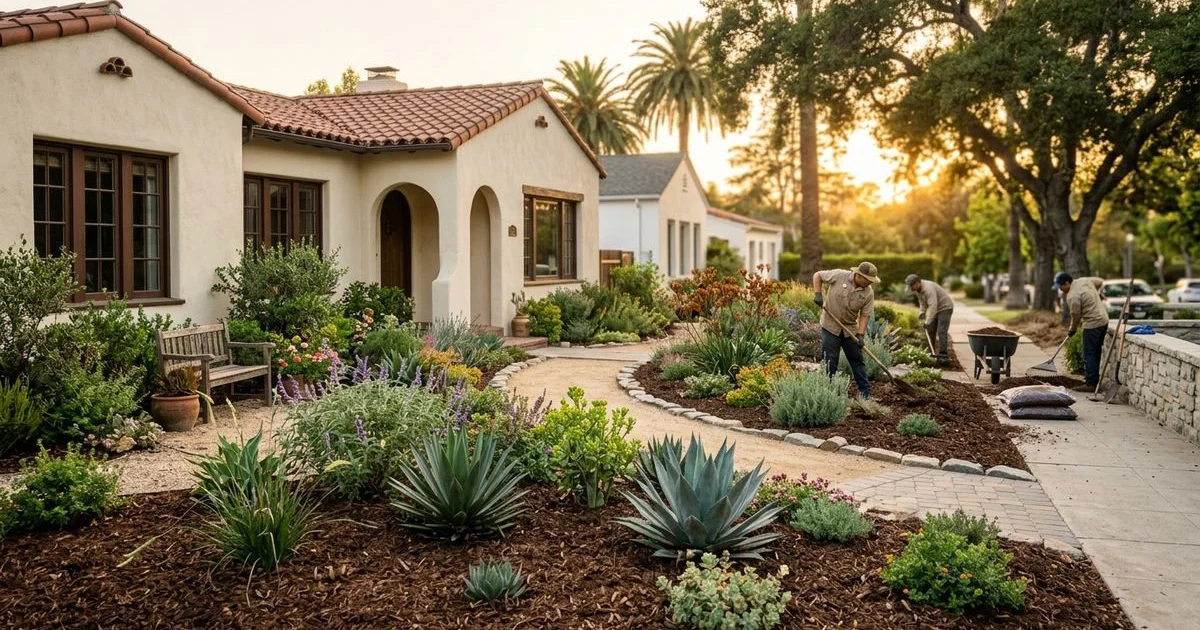
Firewise planting also deserves attention here. CNPS guidance for hot, sunny slopes emphasizes erosion control, drought tolerance, and firewise planting. In foothill settings, those considerations are not optional. A planted slope should be able to withstand dry conditions, avoid excessive fuel load where possible, and support defensible-space planning. Native plants can be part of that approach when they are selected and spaced thoughtfully. The goal is not to sterilize the hillside. The goal is to build a landscape that is both attractive and responsible.
Turf removal needs a plan, not just a shovel
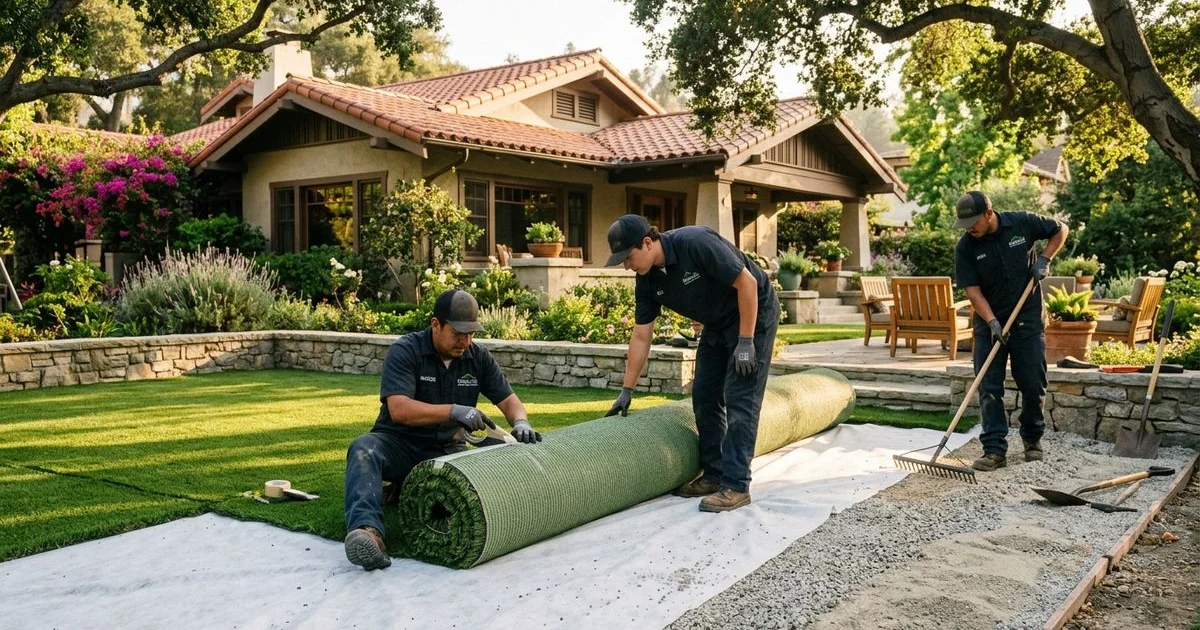
Many sloped yards become more functional once turf is reduced or removed, but turf removal should not be approached casually. California water guidance recommends first assessing irrigation, soil, sun exposure, and plant selection before making that change. That advice is especially important on slopes, where licensed landscapers Pasadena a turf area can hide drainage problems until it is gone and the true conditions are exposed.
Replacing turf with hardscape, terraces, drought-tolerant beds, or a combination of the three can dramatically improve water use. But each choice changes how runoff behaves. A lawn that used to soak up water may be replaced by a patio that sheds it. A planting bed that once stayed moist may become hotter and drier. That is why landscape design on a slope should be studied as a whole. The site needs a new balance, not just a new look.
When turf comes out, irrigation often needs to be recalibrated or fully retrofitted. That is rarely the glamorous part of the project, but it is usually one of the most valuable. A slope planted with native and climate-appropriate species should not be watered like a flat ornamental lawn. Matching water delivery to plant needs saves resources and reduces runoff, which improves the health of the whole system.
HOA rules do not override water efficiency
Homeowners in planned communities often assume that HOA rules can block water-wise upgrades, but California guidance is clear that homeowners’ associations cannot prohibit certain water-efficient landscaping choices during drought-related restrictions. That matters for sloped yards because the pressure to keep a uniform look sometimes conflicts with the need for practical changes.
A hillside property may need terrace walls, erosion control, drought tolerant landscaping, or native habitat gardening to function properly. Those are not cosmetic preferences. They are often the only responsible way to handle the site. If the landscape is in a community with design review, the conversation should focus on how the project preserves the overall character of the property while improving drainage, water efficiency, and slope stability.
That is also where a good landscape designer earns trust. The best proposals do not read like a rebellion against neighborhood standards. They read like a well-considered response to the property’s actual conditions.
A practical way to think about the design sequence
For most sloped yards, the sequence matters as much as the individual elements. Hardscaping should not be installed first and plants figured out later. Drainage should not be postponed until after the decorative work is finished. The site should be read in layers.
A simple way to approach the work is this:
First, understand how water moves across the slope and where the problem areas are. Second, decide which parts of the yard need structure, such as walls, steps, or terraces. Third, choose plant communities that match the microclimate, water demand, and maintenance reality. Fourth, build irrigation around those choices rather than assuming a one-size-fits-all system. Fifth, review how the finished landscape will look and behave during both dry weather and a storm.
That sequence sounds obvious, but in the field it is often where projects succeed or fail. A slope does not forgive shortcuts.
What works especially well in the San Gabriel Valley
The local context matters. The San Gabriel Mountains and surrounding foothill areas support a wide range of native species, including many that are rare or sensitive in the broader region. That ecological backdrop makes native habitat gardening more than a style choice. It is part of respecting the landscape’s identity.
The San Gabriel Valley also has a strong need for water-efficient landscapes in new construction and renovation. That makes hardscaping, drought resistant landscaping, and irrigation efficiency part of the same conversation. A hillside project that responds to the valley’s climate, visual character, and fire concerns will usually age better than one built around imported aesthetics or high-water planting habits.
In practical terms, the best local projects often combine a restrained hardscape palette with native or climate-appropriate planting, clear drainage pathways, and just enough structural intervention to make the slope usable. A terrace for sitting, a stair for access, a dry creek bed for runoff, and a planted matrix that can survive heat and wind, that is a combination that works without demanding constant correction.
The value of restraint
One of the hardest lessons in hillside landscaping is knowing when to stop. It is tempting to solve every issue with more wall, more concrete, more stone, more planting. But the smartest landscapes usually use just enough hardscape to organize the site and just enough planting to let it live. Excess structure can overheat the yard, complicate drainage, and make maintenance harder. Excess planting without structure can leave you with erosion and chronic water waste.
The right balance depends on the slope, the soil, and the level of use the yard needs to support. A family that wants a safe path to a lower garden has different needs than a property that mainly has to protect a hillside from runoff and fire exposure. A shaded pocket on one side of the house may support different plant choices than a sun-baked upper bank. Good landscape design respects those differences instead of smoothing them away.
Hardscaping is most successful when it solves the problem you actually have, not the one a catalog suggests. On sloped properties, that usually means controlling water, reducing erosion, and shaping a yard that belongs to the terrain. When the work is done well, the slope stops feeling like an obstacle and starts functioning as part of the landscape’s character.