
Hardscaping Features That Support Defensible-Space Goals
A good defensible-space plan does more than clear brush and call it a day. In the San Gabriel Valley, where hillside properties, foothill edges, and dry-season conditions all shape how a yard performs, the most durable landscapes usually combine thoughtful plant selection with hardscaping that quietly does a lot of heavy lifting. Retaining walls, decomposed granite paths, gravel bands, patios, drainage swales, and well-placed transitions between home and planting beds can reduce fuel continuity, slow runoff, and make maintenance far more manageable. Done well, hardscaping supports fire-wise goals without making the property feel stark or overengineered.
That balance matters. People often think of hardscaping as decorative, but in practice it is one of the most useful tools in landscape design when the priorities are fire safety, erosion control, and water efficiency. It helps define space, controls how water moves across a site, and creates separation between the house and areas of higher vegetation. On a hillside lot, those functions are not optional extras. They are part of what keeps a landscape stable, usable, and easier to maintain through long dry periods.
Why hardscaping belongs in defensible-space planning
Defensible space is usually discussed in terms of vegetation, and that conversation is important. Plants are still the largest part of most residential landscapes, and choosing drought-tolerant, climate-appropriate species is essential. But hardscaping influences how all of that vegetation behaves. It can interrupt the spread of plant material, reduce laddering between low and higher fuel zones, and create access for routine upkeep. It also gives homeowners a place to manage irrigation transitions, drainage, and foot traffic without trampling sensitive slopes or compacting soil in the wrong places.
That is especially relevant in the San Gabriel Valley, where the visual character of many neighborhoods is tied to hillsides and layered outdoor spaces. Those sites need more than a pretty plan. They need erosion control, runoff management, and a layout that respects slope, sun exposure, and the water needs of each planting area. California’s water conservation guidance emphasizes assessing irrigation, soil, sun exposure, and plant selection before removing turf, and that same logic applies when adding hardscaping. The best hardscape choices make the rest of the landscape easier to water, easier to maintain, and safer in the face of heat and wind.
A common mistake is to treat hardscaping as a substitute for all planting decisions. It is not. Stone, concrete, metal edging, and gravel do not eliminate risk on their own. What they do is create structure. That structure can help separate the home from vegetation, break up continuous fuel, and direct people toward the areas that need the most attention during maintenance season.
The most useful hardscape elements are often the quietest ones
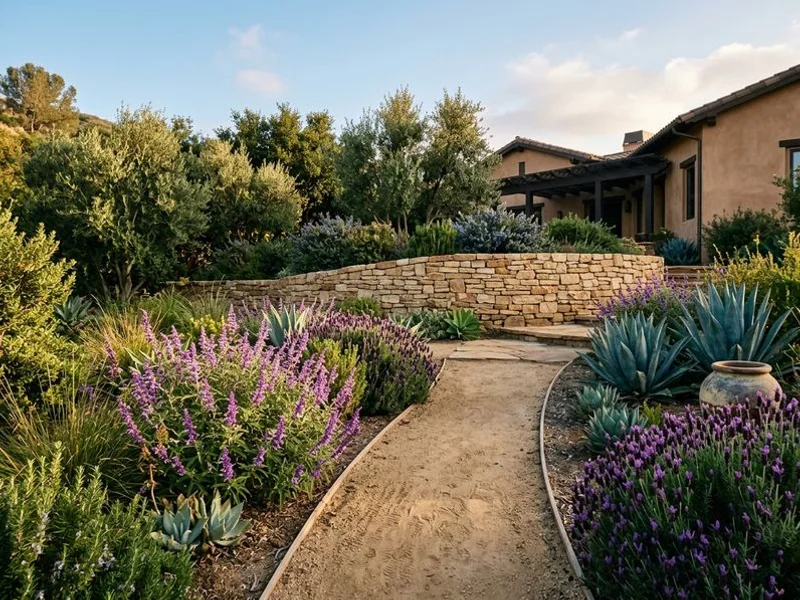
The hardscape features that help most are rarely the flashiest. A wide, clean patio can serve as a noncombustible buffer near the house. A gravel strip can separate foundation plantings from walls. A retaining wall can stabilize a slope while creating a level planting shelf that is easier to irrigate precisely. A paved walkway can reduce the temptation to cross fragile ground, which is particularly useful on hillside landscaping where foot traffic can quickly cause erosion.
When I look at a property through a defensible-space lens, I pay attention to transitions. The space right next to the house should behave differently from the planting areas farther out. Hardscaping helps create those changes in behavior. A patio or paved landing near a rear entry, for example, can function as a low-fuel zone, while the adjacent planting bed can be planted more selectively with species that are appropriate for the local microclimate and maintained with efficient irrigation. The result is a landscape that reads as intentional, not stripped down.
There is also a practical maintenance benefit. Homeowners are much more likely to keep up with a yard when the hardscape gives them clear access for pruning, sweeping, inspection, and irrigation checks. That matters because defensible space is not a one-time project. It has to be maintained, especially after wind events, heat waves, or seasonal growth spurts.
Grading, drainage, and stormwater runoff deserve as much attention as the materials
Hardscaping is not just a list of surfaces. It is a way of shaping water. On sloped properties, poor drainage can do more damage than an underwhelming planting palette. Water that rushes downhill without control can erode soil, undercut planted areas, and leave mulch and fine debris where they do not belong. On the other hand, carefully designed grading, swales, and retaining structures can slow runoff and reduce the chances that soil will wash away during a heavy storm.
That point matters in fire-wise landscapes because erosion and fuel management are connected. Bare, unstable soil is a problem, but so is overbuilt surface coverage that channels water too aggressively. The goal is balance. You want surfaces that are durable enough to protect the site, yet permeable or shaped in ways that keep stormwater from becoming destructive. In many cases, a combination of hardscape and planted zones performs better than a fully paved or fully planted approach.
A thoughtful landscape design often uses hardscape to divide the site into manageable hydrologic sections. A retaining wall can create a bench on a steep slope. A path can define a contour line. A gravel apron can collect and slow runoff at the edge of a driveway or side yard. Even when the project is visually simple, the underlying grading can do a great deal of work. This is especially important on hillsides, where the wrong drainage pattern can quickly turn a good-looking landscape into a maintenance problem.
Hardscaping and drought resistant landscaping should be planned together
Water-wise landscaping is not just about plants that can handle dry weather. It is also about reducing waste and matching the design to how the site actually performs. California’s statewide Model Water Efficient Landscape Ordinance reflects that reality by pushing new and renovated landscapes toward more efficient water use, climate-appropriate plants, and alternative water strategies where appropriate. Hardscaping fits neatly into that mindset because it can reduce the area that requires irrigation and make the remaining planted areas more efficient.
That does not mean replacing every lawn or plant bed with stone. In fact, overusing impermeable or heat-retaining materials can make a yard hotter and less pleasant to live with. The better approach is selective. Use hardscaping where it solves a real problem, such as access, slope stability, separation, or drainage, then allow the planting palette to do the rest. In many San Gabriel Valley settings, that means combining hardscaping with drought resistant landscaping that is chosen carefully for the sun exposure, soil conditions, and irrigation zones on the site.
California’s landscape guidance also points homeowners to plant water-use information that is region-specific. That is useful because not every drought-tolerant plant behaves the same way in every location. Microclimate matters. A plant that thrives on a warm, sheltered slope may struggle in a windier, more exposed section of the same yard. Hardscaping can help here by creating pockets of shade, reflected warmth, or wind protection, which gives the planting design more flexibility.
Materials matter, but placement matters even more
People often start with the material question, as in, should the walkway be stone, concrete, or gravel? That is worth considering, but placement is usually the more important decision. A compact, noncombustible surface near full-service landscaping company the house is useful because it creates distance between structure and vegetation. A gravel zone can work well as a transition area, especially when it is kept clean and not allowed to become a catchall for leaves or debris. Pavers can be effective for patios and paths because they define circulation without making the entire yard feel sealed off.
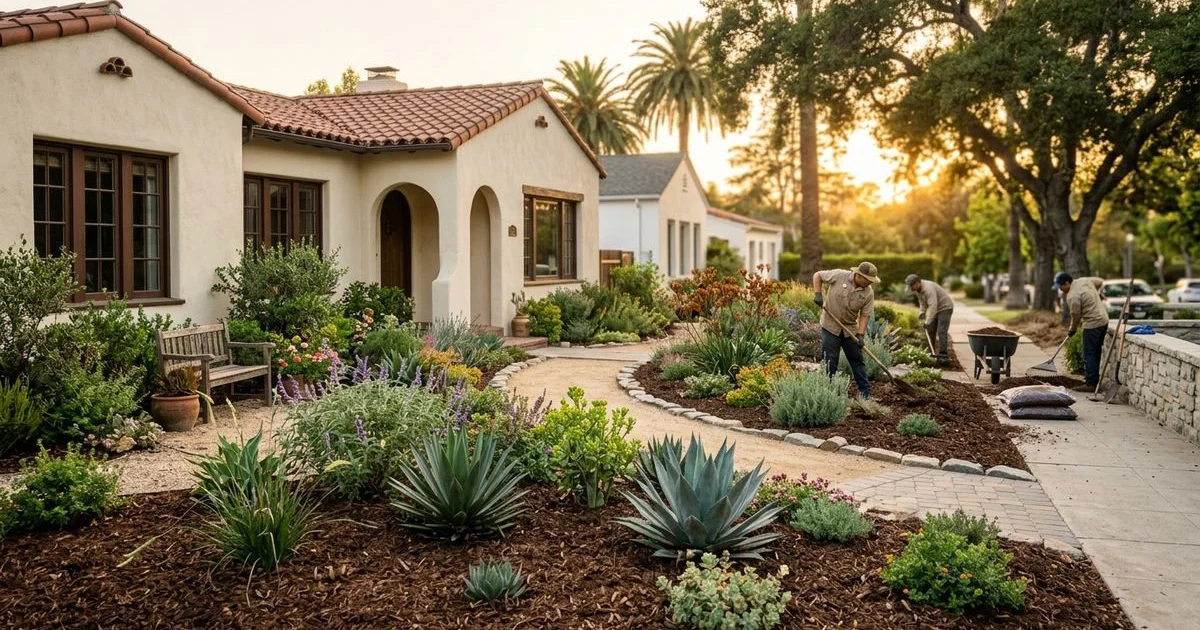
The catch is that each of these materials has to be used with judgment. Gravel can move on slopes if it is not contained properly. Pavers can settle if the base is not prepared correctly. A retaining wall can solve a steep grade issue, but it must be coordinated with drainage so water has somewhere to go. The best installations are the ones where the hardscaping looks almost inevitable, as if the land itself suggested it. That usually happens when the design respects the slope and the irrigation zones instead of forcing a flat plan onto a site that is anything but flat.
In hillside landscaping, this is particularly important. Steeper areas should not be treated like backyard patio extensions. They need erosion control first, then access and visual cohesion. A series of low walls, terraces, and paths can create usable space while reducing pressure on the soil. Those terraces can then be planted with native or climate-appropriate species that do not demand constant watering and do not create dense, continuous fuel right against the house.
Fire-wise planting and hardscaping should reinforce each other
Hardscaping works best when it supports the planting structure rather than competing with it. Near the home, the strongest defensible-space strategies usually involve more open layouts, lower fuel loads, and plants that are maintained with care. Farther out, the landscape can be more naturalistic, especially where the site borders open space or a hillside character is part of the property’s identity. The hardscape elements should help define those zones.
This is where native habitat gardening can be both beautiful and practical. California buckwheat, California sagebrush, manzanita, ceanothus, monkeyflower, foothill penstemon, and bunchgrasses can all fit into a locally appropriate design when they are placed with restraint and maintained properly. These plants also make sense when paired with stone edges, paths, and terraces because the hardscape provides the structure that keeps them from sprawling into areas that need to remain clear. In a defensible-space plan, that separation matters.
The same principle applies to plant density. A well-designed bed is usually not packed edge to edge. It has room for irrigation emitters, pruning access, and air movement. Hardscaping helps preserve those gaps. It also makes it easier to create the transitions that keep a landscape from reading as one continuous mass of fuel. That is especially useful in the San Gabriel Mountains region, where native plant communities are part of the local identity and many rare or sensitive species exist in the broader landscape. A residential yard will never mimic the wildland setting, nor should it try to, but it can reflect the area’s character while still respecting fire-wise priorities.
HOAs, restrictions, and the practical side of getting it done
Homeowners in managed communities sometimes assume that a homeowners’ association can block water-efficient landscaping choices during restrictions. California guidance says that is not the case when it comes to certain water-wise choices. That matters because defensible-space improvements often overlap with drought-tolerant landscaping, turf removal, and irrigation retrofits. If a landscape change reduces water demand and improves safety, it is worth understanding the rules rather than guessing.
That said, compliance is only one part of the picture. The more important question is whether the project will be maintainable. A hardscaped area that collects debris, a gravel strip that migrates into the planting bed, or a terrace without access for pruning can become more trouble than it solves. The same is true for irrigation retrofits. Reducing turf is only useful if the new layout actually supports efficient watering and proper plant placement. California’s water guidance is clear on the point that landscape decisions should be made after evaluating irrigation, soil, sun exposure, and plant needs. Hardscaping should follow that same sequence.
For many homeowners, the smartest route is to start with the functional zones and build outward. Near the house, think in terms of access, separation, and clean surfaces. On the slope, think in terms of erosion control and water movement. In the planting areas, think in terms of microclimate and long-term maintenance. That order prevents the all-too-common mistake of selecting finishes first and then trying to make the site behave accordingly.
A practical way to think about defensible-space hardscaping
It helps to reduce the planning process to a handful of questions that are rooted in how the property actually works. If the answer to any of these questions is unclear, the design is probably not ready yet:
- Where does water move during a storm, and where does it need help slowing down?
- Which areas should remain clear for access, inspection, or maintenance?
- What surfaces can create separation between the home and vegetation without overheating the site?
- Which slopes need terraces, walls, or other erosion control before plants are added?
- Where can drought-tolerant planting and irrigation be concentrated once the hardscape defines the space?
These questions do not produce a one-size-fits-all plan, and that is the point. Defensible-space landscapes are site-specific. A compact courtyard, a broad front yard, and a steep rear slope all call for different hardscape treatments. What they share is the need for structure, drainage awareness, and enough open space around the home to make maintenance realistic.
The best designs feel calm, not defensive
There is a tendency to picture defensible-space landscaping as purely utilitarian, but that is not how good projects usually land. The strongest designs are often the most understated. They use hardscaping to organize space, manage slope, and control runoff, then soften that structure with carefully chosen plants. They respect the dry climate and the local hillside character without trying to hide those realities. They also make the yard easier to live with, which is just as important as the safety function.
That is where hardscaping proves its value. It is not there to dominate the landscape. It is there to give the landscape a spine. In the San Gabriel Valley, where drought resilience, hillside conditions, and defensible-space goals often intersect, that spine can make the difference between a yard that merely looks finished and one that truly works.