
Landscape Design Tips for Reducing Turf Dependency
A turf-heavy yard can look tidy from the curb, but it usually comes with hidden costs that show up in water bills, maintenance hours, and long-term frustration. In the San Gabriel Valley, where hillside properties, dry seasons, and fire safety concerns shape the way landscapes function, reducing lawn area is less a trend than a practical design decision. A good landscape design does not simply replace grass with gravel and call it done. It studies how water moves, how sun hits the site, how soil behaves, and how people actually use the space.
That shift in thinking matters. Turf grass is often the most demanding element in a yard, especially when it is spread across sloped ground or planted in narrow side yards that get baked by afternoon sun. A more resilient landscape uses the site itself to guide the design. The result can be calmer, more visually interesting, and far easier to maintain. In the right hands, hardscaping, native planting, and selective irrigation do not make a yard feel sparse. They make it feel intentional.
Start with what the site is already telling you
The most common mistake I see in turf reduction projects is jumping straight to plant shopping. That usually leads to a patchwork result, where the old lawn is gone but the underlying problems remain. Before changing anything, it helps to look at irrigation coverage, soil condition, sun exposure, and drainage patterns. Those four factors shape almost every decision that follows.
A front yard that gets full afternoon sun does not need the same planting palette as a shaded side slope under mature trees. A compacted clay-heavy patch near a driveway behaves differently from a loose planting bed along a retaining wall. Even within the same property, one corner may dry out quickly while another stays damp after irrigation. A landscape designed to reduce turf dependency should respond to those differences instead of flattening them.
This is where plant selection becomes less about preference and more about fit. Water-wise design works best when the plants are chosen for the actual microclimate, not for a generic “low water” label. In California, region-appropriate guidance such as WUCOLS is useful because it helps narrow plant choices based on local water needs. That is not a minor detail. The right plant in the wrong place still struggles, and struggling plants often need more water, not less.
Why turf reduction is especially relevant in the San Gabriel Valley
The San Gabriel Valley has a very particular landscape character. Many neighborhoods sit against foothills or include sloped lots, and those conditions change how a yard should be planned. Turf on a slope is rarely the easiest answer. It can be harder to irrigate evenly, more vulnerable to runoff, and more difficult to keep lush without wasting water.
There is also the broader regulatory and environmental context. California’s statewide Model Water Efficient Landscape Ordinance shapes water use in new and renovated landscapes, and it encourages native or climate-appropriate plants, efficient irrigation, and alternative water sources. For homeowners, that means turf reduction is not just an aesthetic choice. It is aligned with the direction landscape standards have been moving for years.
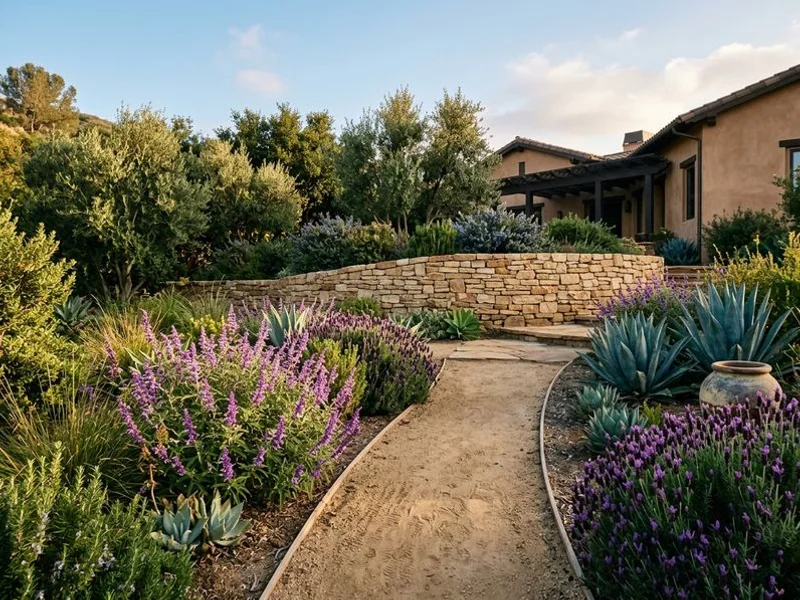
The region’s visual identity matters too. The San Gabriel Valley’s hillside landscapes are part of what gives the area its character, and those views are strongest when plantings feel compatible with the terrain. A yard filled edge to edge with thirsty turf often looks out of place on a slope. Drought resistant landscaping, by contrast, can echo the form of the land itself, using layers of shrubs, bunchgrasses, and groundcovers that hold the soil and soften transitions.
Design for function first, then fill in the beauty
A yard that depends less on turf usually works better when it is divided into zones. The places where people walk, sit, gather, or move equipment should be distinct from the planting areas that mainly provide structure and habitat. That does not mean the design has to feel hard or overly engineered. It means each square foot earns its keep.
Hardscaping often does the heavy lifting here. A small patio, a decomposed granite path, stepping stones, or a simple seating pad can shrink the need for lawn dramatically while making the space more usable. When hardscaping is scaled well, it solves a real problem rather than just filling space. A family that actually uses the patio for morning coffee or a side yard that functions as a shaded passage has far less need for a large turf panel.
I have seen projects where removing only 30 to 50 percent of lawn transformed the entire yard. The key was not total replacement. It was placing the remaining lawn where it had the most value, such as a play area or an open foreground space, then letting the rest of the site do something more efficient.
Where turf still makes sense, and where it usually does not
Not every blade of grass needs to disappear. In some yards, a modest turf area still serves a purpose. The trick is being selective.
A useful way to think about it is this:
- Keep turf where it genuinely gets used, such as a small gathering zone or family activity area.
- Avoid turf on steep slopes, where irrigation and erosion become harder to manage.
- Reduce turf in narrow side yards that function more as circulation space than living space.
- Replace lawn beneath intense afternoon sun if the area is difficult to keep healthy without excess water.
- Reconsider turf anywhere the irrigation system clearly overwaters just to keep it alive.
That last point comes up often. Many lawns survive on habit, not efficiency. Once irrigation is adjusted and the site is studied carefully, the lawn’s true role becomes clearer. Sometimes a small, well-placed patch is enough. Sometimes the space works better as a planted foreground with a path and a bench.
Hillsides ask for a different strategy
Hillside landscaping deserves special attention because slopes introduce two problems at once: water runs off faster, and soil is more vulnerable if the wrong cover is removed too quickly. On steep or uneven ground, turf can be frustrating to maintain and can contribute to erosion if irrigation is not well calibrated.
A stronger approach often relies on deep-rooted, drought-tolerant plantings that help stabilize the soil. Native shrubs, bunchgrasses, and low groundcovers can create a living matrix that protects the slope while still looking natural. In fire-prone areas, planting choices should also support firewise goals and defensible-space planning. That does not mean slopes should be bare or stripped of all vegetation. It means the planting plan should be thoughtful, spaced appropriately, and matched to local conditions.
California native plants are particularly useful here because many of them are adapted to the climate and terrain already present in the region. On San Gabriel Valley properties, plants such as California buckwheat, California sagebrush, manzanita, ceanothus, monkeyflower, foothill penstemon, and bunchgrasses can serve both design and ecological functions. They bring texture and seasonality without demanding constant irrigation. In a hillside setting, that combination is hard to beat.
The point is not to create a botanical collection. It is to build a slope that holds together, looks appropriate, and asks less of the irrigation system.
Plant layers reduce the need for lawn and make the yard feel complete
A landscape with reduced turf can feel unfinished if it is built around only one layer of planting. The best drought resistant landscaping uses layers the way a natural slope does. There is usually a structural layer, often shrubs or small trees. Beneath that sits the middle layer of flowering perennials or compact natives. Groundcovers and bunchgrasses fill gaps and keep the composition from feeling bare.
This layered approach does more than improve appearance. It also reduces maintenance pressure. A dense, well-designed planting scheme shades soil, slows evaporation, and leaves fewer open spaces where weeds tend to move in. It can even create the sense of a larger landscape, because the commercial hardscaping Pasadena eye follows textures and forms instead of stopping at a wide, flat field of turf.
San Gabriel oak, where appropriate, can anchor a design with a strong local identity. Around it, lower plantings can echo the colors and forms of the surrounding foothills. That is the kind of landscape that belongs to its setting rather than fighting it.
Irrigation retrofits make turf reduction pay off
Cutting down lawn area without changing irrigation is a missed opportunity. In many properties, the existing system was designed for a larger turf footprint and now overreaches into planting beds or bare areas. When that happens, water is wasted and new plants suffer.
A turf reduction project is the right moment to rethink the system. Sprinkler heads that once served a broad lawn may need to be reconfigured or replaced. Drip irrigation may make more sense in planted areas, especially where native and climate-appropriate plants are grouped by water need. The goal is not to water less by guesswork. It is to water more precisely.
California guidance emphasizes looking at irrigation as part of the landscape itself, not as an afterthought. That matches the reality on the ground. A well-chosen plant can still fail if it is attached to the wrong irrigation zone or if runoff leaves it dry at the root and wet at the edge. Precision matters more than volume.
One practical habit that helps is grouping plants by similar water needs instead of scattering them randomly. When a landscape is organized this way, the irrigation schedule can be adjusted more intelligently. A bed of California natives should not be treated the same as a thirsty ornamental border. The more consistent the plant groupings, the easier it is to avoid waste.
Soil and drainage deserve as much attention as plant choice
Irrigation gets a lot of attention because it is visible, but drainage is what often decides whether a turf reduction project succeeds. Water that pools along a foundation, runs down a slope, or washes soil into a driveway can undo even the best planting plan. In San Gabriel Valley hillside landscaping, drainage is not optional. It is part of the design language.
Improving drainage may involve regrading small areas, using permeable surfaces in walkways, or directing runoff into planted basins where the soil can absorb it more effectively. Sometimes it means resisting the urge to remove turf all at once before the replacement design is ready. A phased approach gives you room to correct drainage issues before they become expensive.
Soil condition matters too. Compacted soil limits root growth and reduces infiltration, which is a poor match for drought-tolerant plants that need to establish deeply. Before installing new plantings, it is worth taking a hard look at whether the soil needs loosening, amendment, or simply better plant selection. Not every site needs the same fix, but every site needs honest attention.
Firewise planting and water-wise design can work together
Some people assume that drought tolerant landscaping and firewise landscaping pull in opposite directions. In practice, they often overlap. The same qualities that make a landscape water-efficient, such as careful plant placement, reduced fuel continuity, and an appropriate plant palette, can also support defensible-space goals.
That does not mean any low-water plant is automatically the right choice near a home. Plant form, spacing, and maintenance still matter. A neat, well-maintained planting bed is different from a tangled mass of dry debris. Fire safety depends as much on upkeep as on species selection. In a landscape that reduces turf, regular pruning, debris removal, and thoughtful spacing become part of the design itself.
This is especially relevant near the San Gabriel Mountains, where native habitat, steep terrain, and residential edges meet. The best results come from balancing ecological fit with household safety. A yard can be beautiful, local, and more resilient without being overbuilt or overwatered.
A practical sequence for a turf reduction project
When a yard feels overwhelming, breaking the work into order helps keep the project grounded. The exact sequence will vary, but the logic stays similar.
- Study the site first, including sun exposure, irrigation coverage, soil condition, and slope.
- Decide which areas, if any, truly need turf and which can become paths, planting beds, or patio space.
- Choose plants that suit the microclimate and water needs of the site, using region-appropriate guidance.
- Retrofit irrigation so new planting zones are watered efficiently and turf zones are not over-served.
- Build in drainage and erosion control before the new landscape is finished.
That sequence prevents a very common mistake, which is treating turf removal as the finish line. Turf removal is only the opening move. The real work is designing what replaces it so the new landscape is more functional than the old one.
HOA concerns, neighborhood expectations, and the value of a clear plan
In many neighborhoods, homeowners worry that reducing turf will clash with HOA rules or nearby expectations. California guidance makes clear that during drought-related restrictions, homeowners’ associations cannot prohibit certain water-efficient landscaping choices. That does not erase every design review or neighborhood concern, but it does remove one of the biggest myths that still circulates around lawn replacement.
A well-composed turf reduction plan usually eases those concerns anyway. A finished landscape with consistent plant groupings, clean hardscaping, and visible maintenance looks deliberate, not improvised. It tends to age better too. Instead of chasing the look of a lawn that wants more water than the site can reasonably give, the yard settles into a lower-maintenance rhythm that suits the climate.
That is the deeper value of landscape design in this context. It is not simply about doing less. It is about choosing where to spend water, where to invest structure, and where to let plants do the work that turf used to do badly. In the San Gabriel Valley, where water-wise design, hillside conditions, and fire safety all intersect, that approach is not a compromise. It is a better fit for the land.