
This page explains how to get in touch about Teeth Whitening, what information is useful to include, and what happens once an enquiry is received. It is written to make the first exchange more useful, because a well-formed enquiry usually saves an entire round of correspondence.
Most whitening enquiries fall into one of three categories. Some people want to know whether the treatment is suitable for them specifically, usually because of an existing crown, a history of sensitivity, or discolouration they suspect is not the ordinary kind. Others already know they want treatment and are asking about practicalities. A third group is comparing providers and wants to understand what a service includes before committing. All three are reasonable, and each benefits from slightly different information being included at the outset.
Contact Details
What to Include in Your Enquiry
The following details allow a more useful reply. None of them is required, and an enquiry without them is perfectly welcome — but including what you can will generally get you a substantive answer rather than a request for more information.
Your Name and How to Reply
A name and a preferred method of reply. If a particular time of day suits you better for a telephone conversation, saying so avoids a sequence of missed calls.
What You Are Asking About
A single line is enough. “Is whitening suitable if I have a crown at the front?” produces a far more useful reply than a general request for information, because it identifies immediately what actually needs answering.
Relevant Dental History
Particularly useful: existing crowns, veneers, bridges or visible fillings and roughly where they are; any history of sensitivity to cold or to previous whitening; any current dental problem such as pain, bleeding gums or a tooth you are already concerned about; and whether you have had whitening before and how your teeth responded. This last point is often the most informative single detail you can provide.
Your Location
A postcode is helpful if you are asking about home visit treatment, since coverage areas have limits.
Any Date You Are Working Towards
If you are treating ahead of a wedding, holiday or other event, mention the date. Timing advice differs depending on how much room there is — one to two weeks before the date is generally sensible, and knowing the deadline changes what can usefully be recommended.
Accessibility or Additional Needs
Anything that would make an appointment easier: mobility requirements, a need for extra time, dental anxiety, or a preference for a particular format of communication. Raising it at the enquiry stage means arrangements are made in advance rather than improvised.
What Happens After You Get in Touch
The sequence below is what a properly run enquiry process looks like. It is set out so that you know what to expect and can recognise if something has been skipped.
Your Enquiry Is Reviewed
Your question is read alongside any dental history you have provided, so that the reply addresses your circumstances rather than offering general information.
You Receive a Reply
Answering what was asked, and flagging anything that cannot responsibly be determined without an examination. Some questions genuinely cannot be settled remotely, and you should be told so plainly rather than given a confident guess.
A Consultation Is Arranged
Where appropriate, an assessment is arranged. This is where suitability is actually established: medical and dental history reviewed, mouth examined, restorations identified, and baseline shade and sensitivity recorded.
Your Options Are Explained
What is realistic for your teeth specifically, how many sessions may be needed, how existing restorations will behave, what the aftercare requires, and what the treatment costs. Including, where relevant, being told that whitening is not the right approach for your case.
You Decide
With the information in front of you and without pressure to commit during the consultation itself. There is no reason a decision about an elective cosmetic treatment needs to be made on the spot.
What Cannot Be Determined Without an Examination
Some questions can be answered by correspondence and some cannot. Being clear about which is which is more useful than an encouraging reply that turns out to be wrong.
Whether Your Discolouration Will Respond
Extrinsic staining from food, drink and tobacco responds most predictably. Intrinsic discolouration originating within the tooth responds less predictably, and grey tones are generally the most resistant of all. Distinguishing between them requires examining the teeth. Photographs are not a reliable substitute, because lighting and camera settings alter apparent shade considerably.
How Much Change to Expect
This depends on your baseline shade, enamel condition, type of staining and existing restorations. It is established at assessment against a standardised shade guide. Any figure offered before that has been produced without the information needed to support it.
Whether Treatment Is Appropriate Right Now
Active decay or gum disease is stabilised before cosmetic treatment. Neither can be ruled out remotely, and both are reasonably common in people who have not had a check-up recently.
Anything Involving Current Symptoms
If you are experiencing dental pain, bleeding gums, a tooth that has changed colour on its own, or any discomfort that is not settling, that requires assessment by a registered dental professional as a clinical matter. It should be dealt with before any cosmetic treatment is considered, and it is not something to work around.
Preparing for Your Consultation
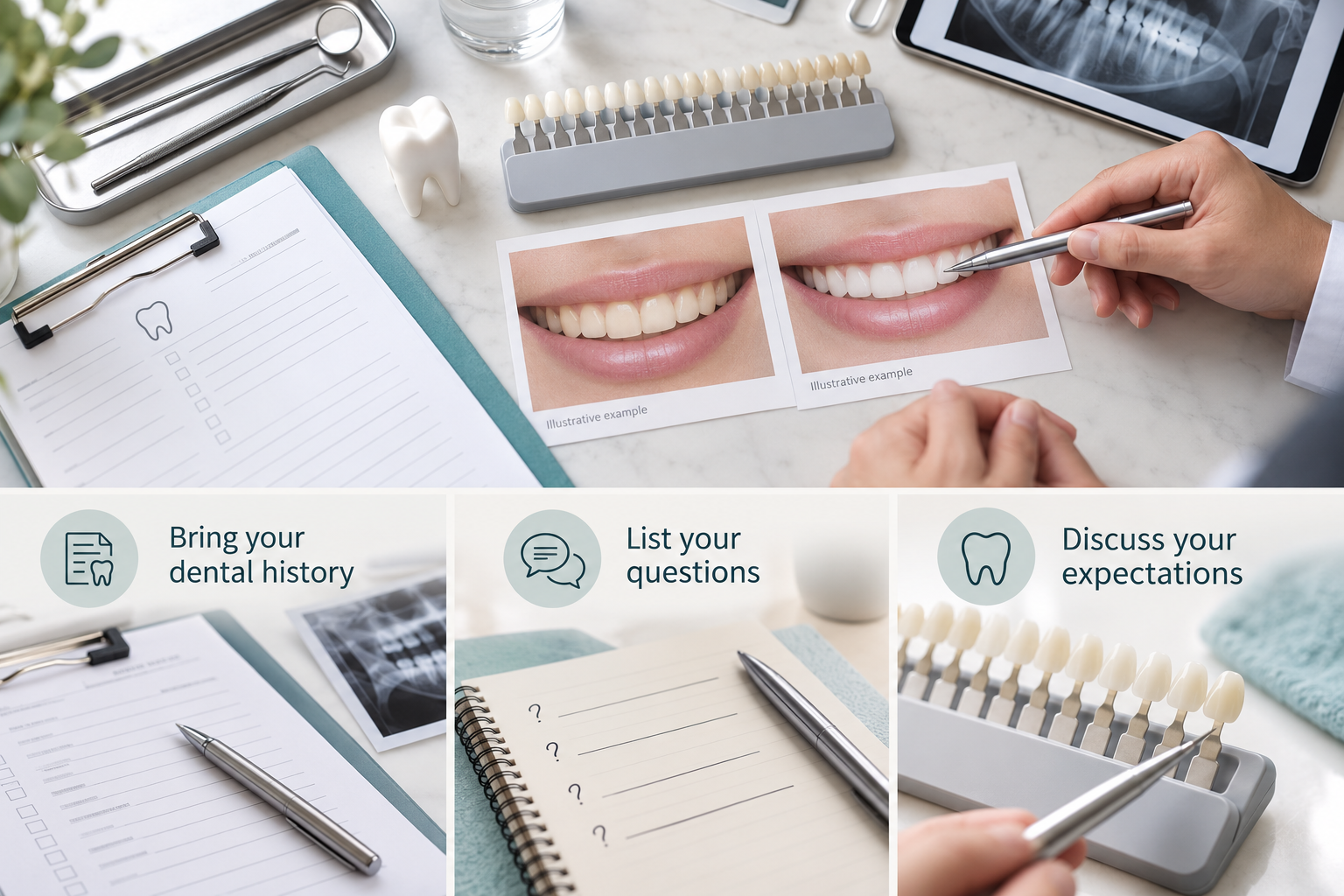
A short amount of preparation makes the appointment considerably more productive.
Bring a List of Medications
Including anything taken occasionally and any supplements. It is easier to bring a list than to recall accurately under questioning.
Know Your Dental History
Roughly when your restorations were placed, any previous whitening and how your teeth responded, and any recurring sensitivity. Approximate answers are fine; the pattern is what matters.
Think About What You Want
“Brighter” is a broad target. It is worth considering whether you are aiming to reverse gradual yellowing, address specific staining, or match a restoration you already have. The clearer your goal, the more directly the consultation can address whether it is achievable.
Bring Your Questions Written Down
People routinely leave consultations having forgotten the thing they most wanted to ask. A note on your phone is sufficient.
Consider Timing
If you are working towards a date, mention it early in the conversation rather than at the end, since it affects what can sensibly be recommended.
It may be useful to read what the treatment involves, how outcomes are measured, the published pricing, and what to look for in a provider. Several of the most common enquiry questions are answered across those pages.
How Your Information Is Handled
Information you provide in an enquiry is used to respond to that enquiry. Details about your dental history are handled with the confidentiality appropriate to health information, and are not used for unrelated purposes.
Full details of how personal information is collected, stored and used are set out in the Privacy Policy. The terms governing use of this website are set out in the Terms & Conditions.
The information on this website is general and does not constitute clinical advice, diagnosis or treatment. It is not a substitute for consultation with a registered dental professional, who is the appropriate person to advise on your individual circumstances.