
Whitening prices vary more widely than almost any other cosmetic dental treatment, and the range is confusing because the headline figure rarely describes the same thing twice. One price includes an assessment, a professional clean, a full supervised session and written aftercare. Another covers a single application with none of the surrounding care. A third is for a product you apply yourself. Comparing those figures directly tells you very little.
This page sets out the published prices, explains precisely what is included, and then does the more useful work of explaining what drives cost in this treatment generally. By the end you should be able to read any whitening quotation — from anywhere — and understand what you are actually being quoted for.
Two principles are worth stating at the outset. The first is that the cheapest option is frequently not the least expensive, because whitening products that produce partial results tend to be replaced rather than abandoned, and those repeat purchases accumulate quietly. The second is that no price is good value if the treatment was never going to achieve what you wanted. Suitability is established at assessment, and an assessment that tells you whitening is the wrong approach for your particular discolouration has saved you the entire cost.
All figures on this page are the published prices for the period stated. Prices should be confirmed directly at the point of booking, since availability and any promotional pricing can change.
Teeth Whitening Prices — August 2026
The following prices apply to home visit treatment, where the Teeth Whitening session is carried out at your own address rather than at a clinic.
Home Visit — One Person
One laser Teeth Whitening treatment carried out in your home.
Home Visit — Two People
Two laser Teeth Whitening treatments carried out in your home at the same appointment.
Only home visit pricing is published above. No figure is quoted here for in-clinic treatment, top-up sessions, supervised take-home maintenance, or group bookings beyond two people because none has been published, and an invented estimate would be worse than none at all.
Reading the Two-Person Price
The two-person arrangement is priced lower per head because a single visit covers both treatments — one journey, one set-up, one appointment window. The saving is structural rather than a discount on the treatment itself, which is identical in both cases. It is worth noting that both people are assessed individually; a shared appointment does not mean a shared assessment, and either person may be advised that treatment should be deferred.
What the Price Includes
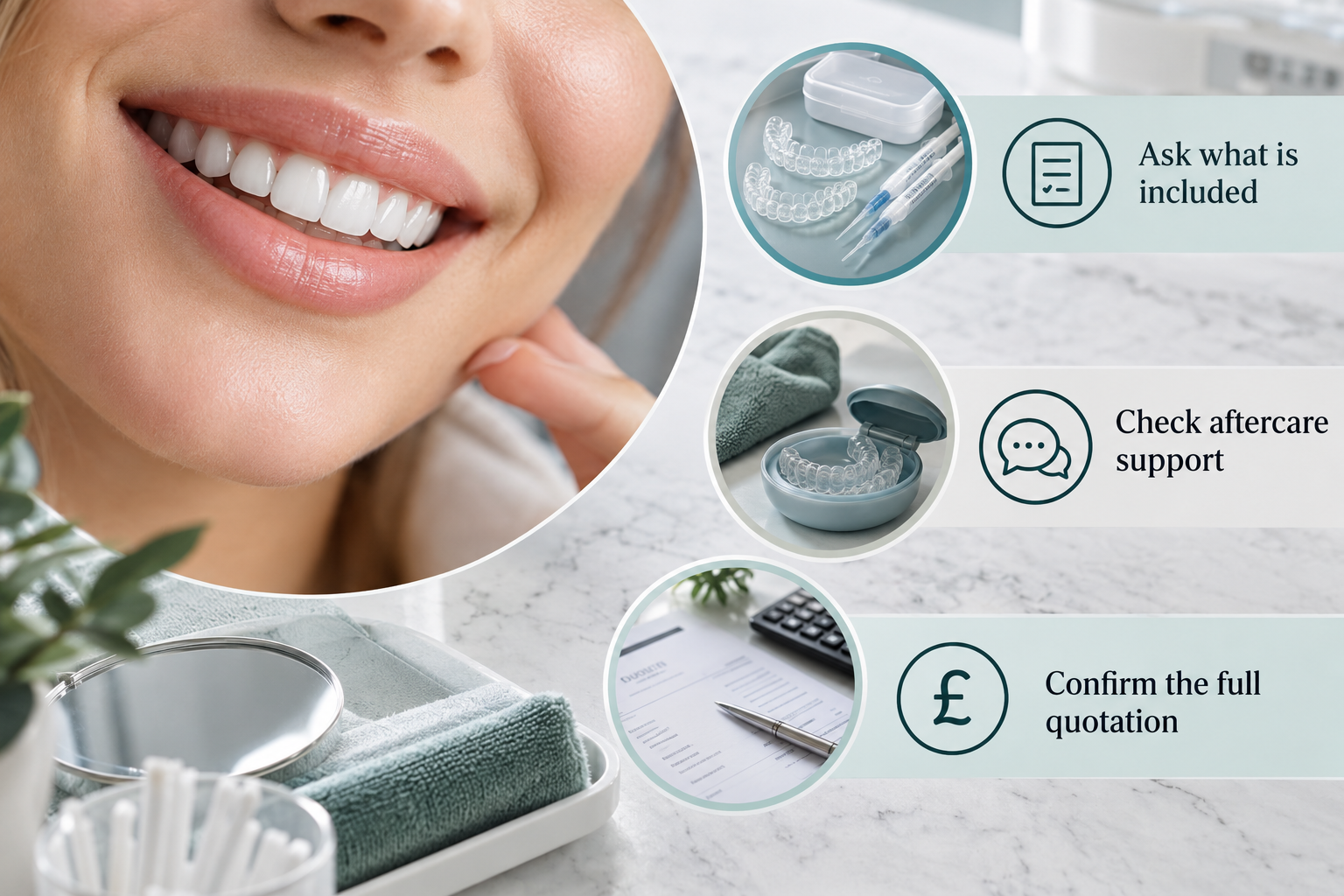
A whitening price should cover the whole service rather than the application alone. The components below are what a complete Teeth Whitening service comprises, and they are the items to check for in any quotation you are comparing.
Pre-Treatment Assessment
Review of medical history and current medications, examination of the mouth for decay, gum health, enamel wear and existing restorations, and a discussion of your goals against what is realistically achievable for your teeth. This is the component most frequently missing from cheaper offers, and it is the one that determines whether the rest is worth doing.
Baseline Shade Recording
Your starting shade recorded against a standardised guide, with clinical photographs under consistent lighting where appropriate. Without this there is no objective way to establish afterwards what the treatment achieved.
Soft Tissue Protection
Lip retractors and a gingival barrier applied before any gel contacts the teeth. This is what prevents the most common avoidable complication of whitening, and it is not optional in a properly conducted session.
The Supervised Session
Professional-strength gel applied in measured amounts across the natural tooth surfaces, with activation cycles run for defined intervals and the gel reapplied as the protocol requires. Supervision throughout means exposure can be shortened or the approach adjusted if you report discomfort during the session rather than after it.
Post-Treatment Assessment
Gel removal, rinsing, shade re-recorded against the same guide used at baseline, and a sensitivity assessment before the appointment ends.
Written Aftercare Guidance
Specific guidance covering the first forty-eight hours and the weeks that follow. Given that aftercare during the initial window has a disproportionate effect on how the result settles, guidance issued verbally and half-remembered is materially less useful than guidance issued in writing.
When comparing two prices, ask which of the six components above each one includes. A lower price that omits assessment, shade recording and aftercare is not the same treatment offered more cheaply — it is a different and smaller service.
Home Visit Treatment
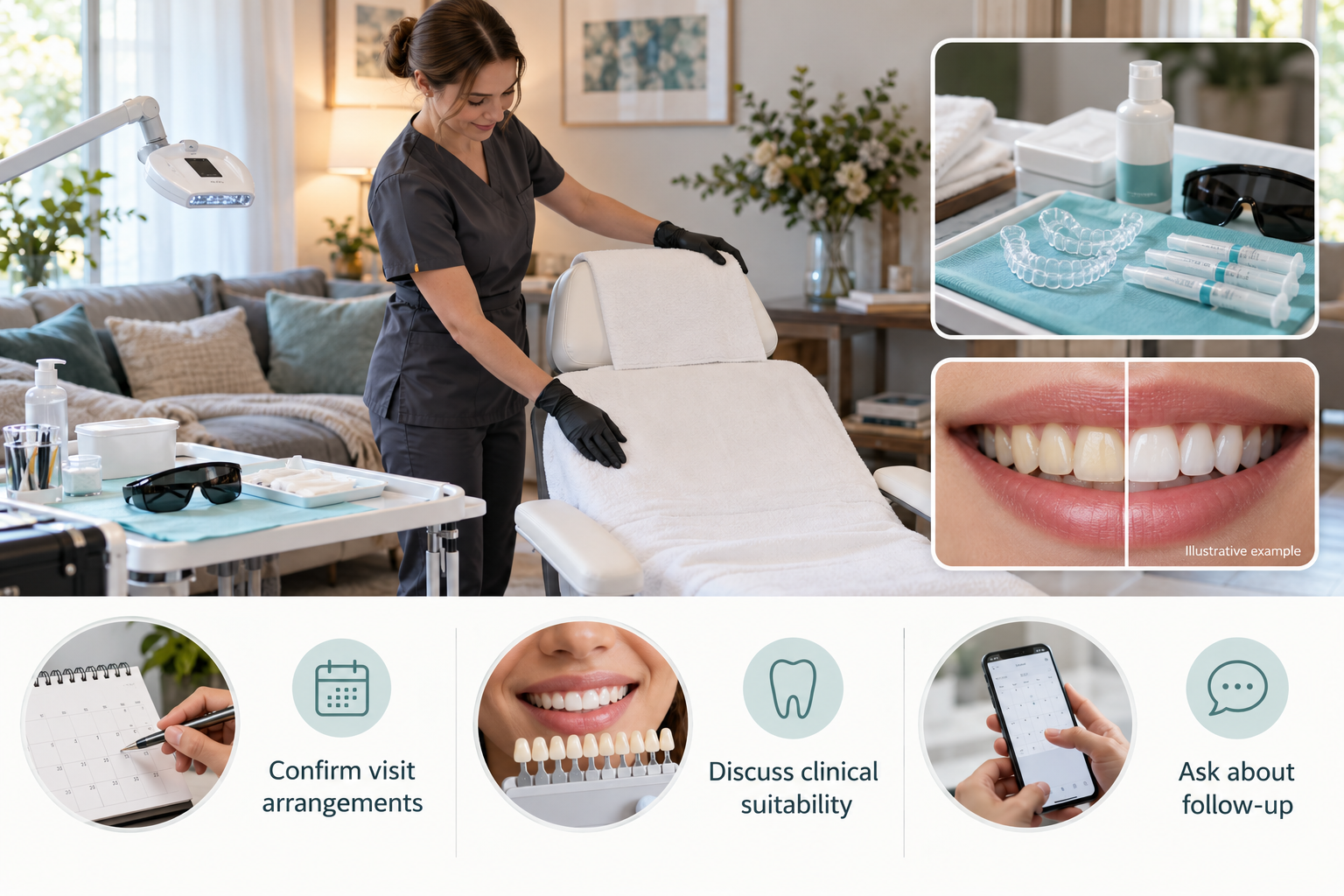
Home visit treatment brings the Teeth Whitening session to your address instead of requiring you to attend a clinic. The treatment protocol itself is unchanged; what changes is where it takes place and what that means practically.
Who Tends to Choose It
People who cannot easily take time out of a working day, parents without straightforward childcare arrangements, people with limited mobility or transport, and anyone who simply finds a clinical setting uncomfortable. Two people treated at one appointment — a couple before a wedding, two members of a household — is also a common arrangement, and is priced accordingly.
What to Prepare
A quiet space with a chair or sofa where you can sit comfortably and still for around an hour, reasonable lighting, and access to a sink for rinsing. Nothing beyond that is required.
What Does Not Change
Assessment, soft tissue protection, shade recording, supervision throughout the session, and aftercare guidance all apply exactly as they would in a clinic. A home visit is a change of venue, not a reduced service, and any provider offering it as a reduced service should be treated with caution.
What Drives the Cost of Teeth Whitening
Understanding the underlying cost drivers explains most of the variation you will encounter, and it makes the differences between quotations legible rather than arbitrary.
Who Carries Out the Treatment
Professional-strength whitening agents require appropriate training to use, and in the UK whitening must be carried out by, or under the direct supervision of, a registered dental professional. Training, registration, indemnity and continuing professional development all carry real cost, and that cost is reflected in the price. It is also the single largest difference between a supervised treatment and an unsupervised one.
The Depth of Assessment
A thorough assessment takes clinical time. Reviewing medical history, examining for decay and gum disease, identifying restorations, recording baseline shade and sensitivity, and having an honest conversation about realistic outcomes cannot be compressed into a few minutes. Where a price looks unusually low, shortened assessment is one of the most common explanations.
Materials and Equipment
Professional-strength gels, barrier materials, retractors, single-use items and activation equipment all carry cost, and equipment requires maintenance and periodic replacement. These are genuine inputs rather than markup.
Session Length and Number
A longer session, or more than one session, uses more clinical time and more material. Where a treatment plan involves a follow-up session, that should be priced and explained at the outset rather than presented afterwards as an additional requirement.
Setting
A clinic carries premises, staffing and equipment costs. A home visit carries travel and time costs instead. Neither is inherently cheaper; they are different cost structures, and which represents better value depends on what your own time and travel are worth to you.
Aftercare and Follow-Up
Written aftercare guidance, availability for questions afterwards, and a follow-up assessment where needed all form part of the service. Where these are absent, the price is lower because the service is smaller.
Comparing Whitening Options on Cost
The table below compares the broad categories of whitening on the factors that determine total cost rather than headline price. It is intended to make the trade-offs explicit rather than to argue for one option.
| Option | Cost characteristics | What to weigh |
|---|---|---|
| In-clinic supervised | Higher single cost covering assessment, supervised session, shade documentation and aftercare. Cost is known before you commit. | The largest outlay at the point of treatment, and the one with the most predictable outcome and the clearest accountability. |
| Home visit supervised | Comparable to in-clinic treatment, with travel replacing premises cost. No travel or time off work required of you. | Worth comparing against what a clinic visit would cost you in travel and lost time, which is frequently overlooked. |
| Supervised take-home trays | Moderate cost including custom-fitted trays and professionally selected gel. Refill gel is an ongoing cost. | Depends on consistent use over days or weeks. Excellent for maintenance; slower for an initial change. |
| Over-the-counter kits | Low individual cost, frequently repeated. Total spend accumulates without being tracked. | No assessment, so no way of knowing whether your discolouration was ever going to respond. Uneven application is common. |
| Whitening toothpastes | Low recurring cost as part of ordinary shopping. | Useful for maintaining a result, not for producing one. Highly abrasive formulations trade enamel for surface stain. |
| Unregulated services | Often priced below supervised treatment. | In the UK whitening must be carried out by or under the supervision of a registered dental professional. A price below the cost of doing that properly warrants scrutiny. |
The Cost That Accumulates Quietly
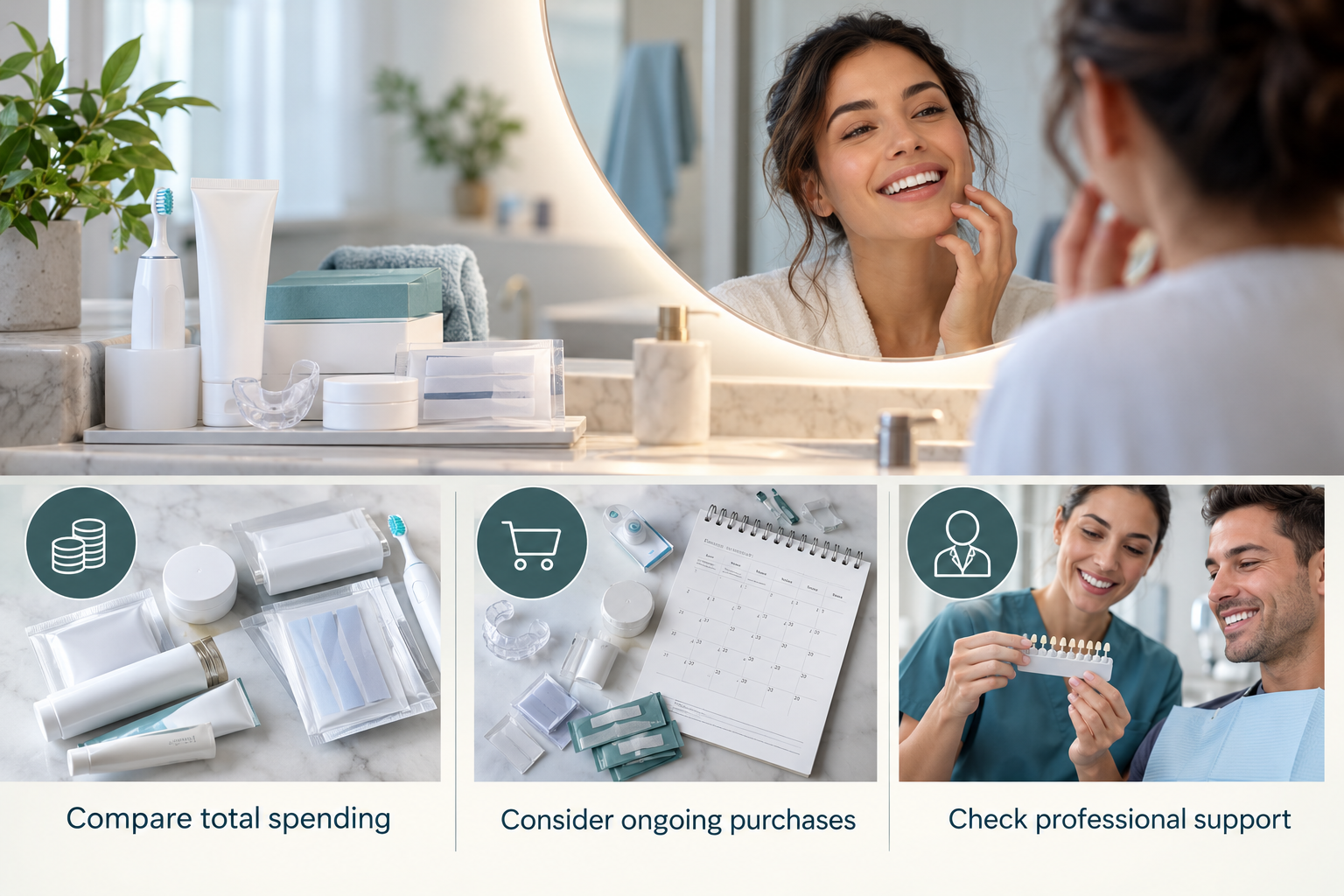
The most common pattern in whitening spending is not a single large purchase. It is a sequence of small ones spread across a year or two, none of which felt significant at the time, and which together frequently exceed the cost of a supervised treatment.
How the Pattern Runs
It usually begins with a whitening toothpaste. When that produces little visible change, a strip or gel kit follows. When that produces partial or uneven change, a stronger kit or a different brand replaces it. Somewhere in the sequence an LED device is added. Each individual purchase is modest, none is recorded, and the total is never calculated because there is no single moment at which it presents itself.
Why It Frequently Ends Without a Result
Consumer products are formulated for a general population because they have no information about the individual using them. If your discolouration is intrinsic, no over-the-counter product will address it meaningfully, and you can continue purchasing indefinitely without approaching the outcome you want. The only way to know which category applies to you is an assessment — which is precisely what the consumer route omits.
The Correction Cost
Uneven application produces patchy shade, which is more difficult to correct than the original uniform discolouration. Overuse of abrasive products wears enamel, exposing more of the darker dentine beneath and moving the appearance in the opposite direction to the one intended. Neither outcome is common, but both are more expensive to address than the original problem.
Add up what you have already spent on whitening products over the past two years. Most people are surprised by the figure, and it changes how the cost of a supervised treatment reads — not because the treatment is cheaper, but because the comparison was never really against zero.
Budgeting for Maintenance
Whitening is not permanent, so the honest way to think about cost is across the period you want the result to last rather than at the point of treatment alone. Planning for maintenance is considerably cheaper than reacting to relapse.
Professional Cleaning
Regular professional cleaning removes accumulated surface deposits that daily brushing leaves behind, and often restores a noticeable amount of brightness on its own. For many people this delays the point at which a top-up becomes worthwhile, and it is an appointment worth having regardless of appearance.
Top-Up Sessions
A top-up is shorter and lighter than an initial course. The interval varies with your habits rather than following a fixed schedule — a non-smoker who drinks mostly water may go considerably longer between top-ups than a daily coffee drinker who smokes. Your clinician can suggest a realistic interval once your shade has been observed over time.
Everyday Products
A non-abrasive fluoride toothpaste and interdental cleaning are ordinary oral care costs rather than whitening costs, and they do more to protect a result than any specialist product. Where a desensitising toothpaste is recommended, that is a modest additional item.
What Reduces Maintenance Cost Most
Habits, not products. Moderating pigmented food and drink, rinsing with water afterwards, not brushing for around thirty minutes after anything acidic, and stopping tobacco all extend a result further than any purchasable item. The most effective maintenance measures are free.
Questions Worth Asking Before You Book
These questions apply to any provider. A provider who answers them clearly is giving you the information you need to decide; one who deflects them is telling you something too.
Who will carry out the treatment?
Whitening must be carried out by, or under the direct supervision of, a registered dental professional. Ask who that is and confirm their registration.
Is assessment included in the price?
If assessment is charged separately, that changes the comparison. If it is not offered at all, that changes it more.
Will my baseline shade be recorded?
Without a documented starting point there is no objective way to establish afterwards what the treatment achieved.
How many sessions are likely?
If a second session is probable, it should be discussed and priced before you commit rather than introduced afterwards.
How will my restorations behave?
Crowns, veneers and composite fillings do not change shade. If they are visible when you smile, this needs discussing before treatment.
What happens if I get sensitivity?
Ask what support is available afterwards, whether follow-up is included, and how to make contact if something does not settle.
Why Two Quotations Can Differ So Widely
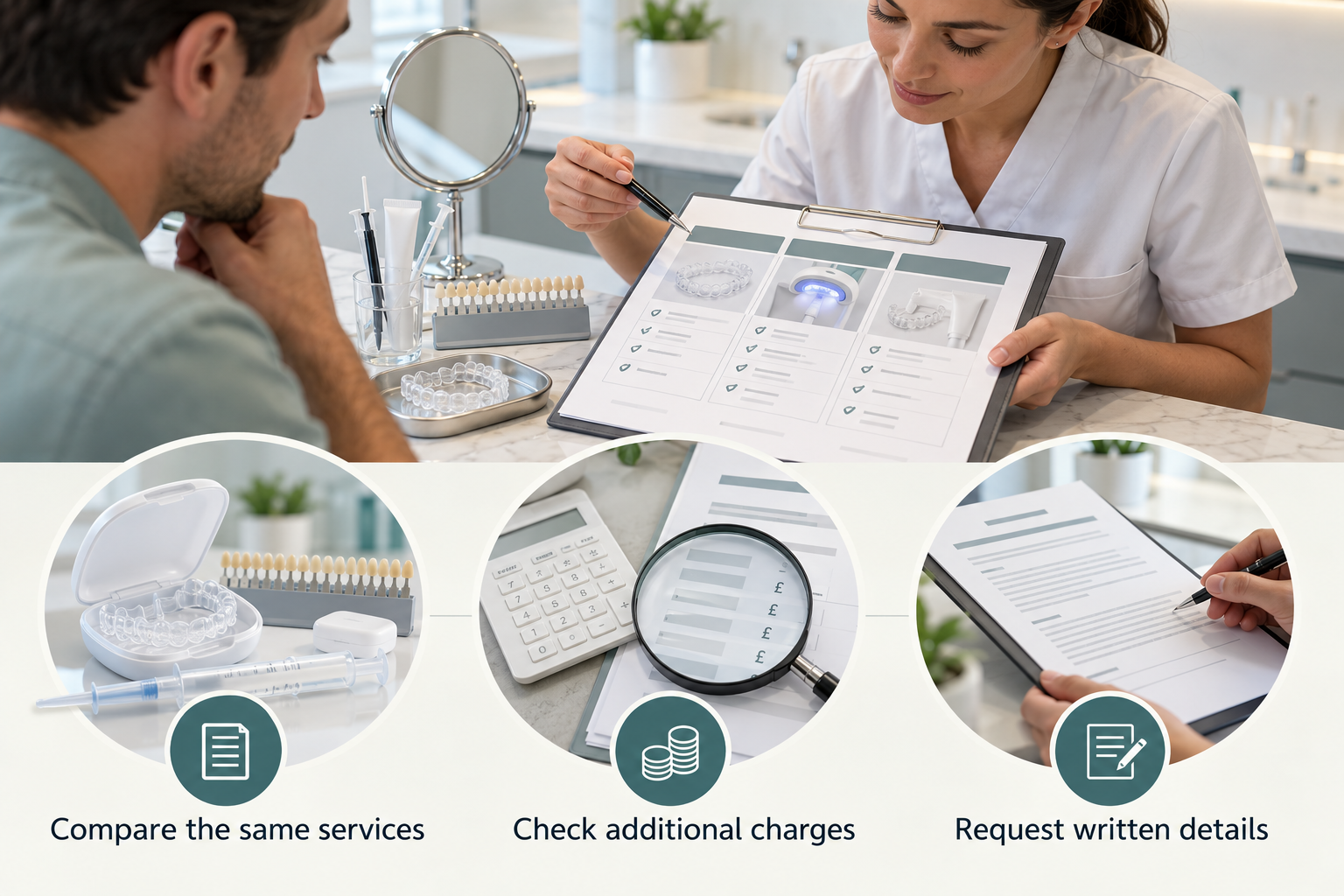
It is common to receive quotations for what appears to be the same treatment that differ by a factor of two or more. That range is not arbitrary, and once you know what produces it the comparison becomes straightforward.
The Quotation Covers a Different Scope
This is the largest source of variation. One quotation covers assessment, professional cleaning, a full supervised session, shade documentation, aftercare guidance and follow-up availability. Another covers the application alone, with assessment charged separately or omitted entirely and no follow-up included. Both may be described in a single line as “teeth whitening”. Asking each provider to itemise what is included converts an apparently unfair comparison into a legible one.
A Second Session Is Assumed or Excluded
Some quotations assume a single session and price accordingly, with any further session charged as an additional treatment. Others build a likely second session into the quoted figure. Neither approach is wrong, but comparing one against the other without knowing which is which produces a misleading result. Ask directly whether the figure covers one session or a course.
The Setting Carries Different Costs
Premises, staffing and equipment costs differ substantially between a high street clinic, a treatment room within a larger practice, and a mobile service. None of these structures is inherently better value; they distribute cost differently. A home visit removes your travel and time cost entirely, which is a real saving that never appears on any quotation.
Different Products and Protocols
Gel concentration, activation system, barrier materials and the number of application cycles all differ between protocols, and all carry different material costs. A protocol using several application cycles within one appointment uses more material and more clinical time than a single application.
Promotional Pricing
A promotional price is a genuine reduction on a standard price, and it is legitimate. What is worth checking is what the standard price is, whether the promotional figure covers the same scope as the standard one, and how long it applies. A promotion that quietly excludes assessment is a change of scope rather than a reduction in price.
The Comparison That Actually Works
Ask each provider the same four questions: what is included, who carries out the treatment, whether a further session is likely and at what cost, and what support is available afterwards. Four answers from each provider makes the comparison direct. Comparing headline figures alone almost never does.
Cost Implications of Existing Dental Work
This is the cost consideration most frequently discovered too late, and it has nothing to do with the price of the whitening itself. Crowns, veneers, bridges and composite fillings do not change shade. Whitening the natural teeth around them increases the contrast between the two.
Why It Matters Financially
If you have a visible crown on a front tooth that currently matches your natural shade, whitening the surrounding teeth will make that crown appear darker by comparison, because it stays exactly where it was while everything around it lightens. Restoring the match means replacing the restoration, which is a substantially larger expense than the whitening. Nobody wants to learn this after treatment.
How It Should Be Handled
Existing restorations are identified at assessment and their position relative to your smile line is discussed before treatment. Where the contrast would be noticeable, you have three real options, and a provider should set out all of them: proceed and accept the contrast, proceed and plan to replace the restoration afterwards, or decide that whitening is not the right approach for your particular arrangement of natural and restored teeth.
Sequencing Where Restorations Are Planned
If you are already planning restorative work on a visible tooth, the sequence matters and it saves money. Whitening first, allowing the shade to settle, and then matching the new restoration to the settled shade means the restoration is made once. Placing the restoration first and whitening afterwards frequently means paying for it twice.
Where Restorations Are Extensive
Where many visible teeth are restored, whitening may not be the appropriate treatment at all. Restorative options including veneers, crowns or composite bonding address the appearance of the whole smile rather than only the natural elements of it. A provider who identifies this at assessment and says so has saved you the cost of a treatment that could not have delivered what you wanted.
Sensitivity Management and the Cost of Support
Short-term sensitivity is the most commonly reported effect of Teeth Whitening. How a provider handles it is both a clinical matter and a cost one, because managing it properly requires time, materials and availability afterwards.
What Proper Management Involves
Baseline sensitivity recorded before treatment so any change can be interpreted rather than guessed at. Concentration and exposure selected with that history in mind. A desensitising agent available for immediate application after treatment. Guidance on starting a desensitising toothpaste before the appointment where your history warrants it. Each of these is a real input, and a price that omits them is lower for a reason.
Availability Afterwards
Sensitivity that intensifies rather than settling, or persists beyond roughly a week, warrants a follow-up assessment. Whether that assessment is included in your original price or charged separately is worth establishing before treatment rather than at the point you need it. A provider who includes follow-up is carrying a cost that a provider who does not has avoided.
Why This Should Not Be the Place to Economise
Sensitivity is common, usually mild and usually short-lived. The cases where it is not are exactly the cases where support matters, and they are impossible to identify in advance. Paying slightly more for a service that includes follow-up buys you cover for the situation you cannot predict, which is what it is for.
Questions Worth Asking
- Is a desensitising agent applied after treatment as standard?
- Should I start a desensitising toothpaste before my appointment?
- Is a follow-up assessment included if sensitivity does not settle?
- How do I make contact in the days after treatment if I need to?
Common Misunderstandings About Whitening Prices
Five assumptions come up repeatedly and each of them distorts the decision in a predictable way.
“A higher price means a whiter result”
It does not. The outcome is determined principally by your type of staining, your baseline shade, your enamel condition and your existing restorations — none of which a higher price alters. What a higher price should buy is assessment, supervision, protection and support, which affect whether the treatment is appropriate and safe rather than how light your teeth become.
“It is a one-off cost”
Whitening is not permanent. Shade relapses gradually through ordinary eating and drinking, and periodic maintenance is part of the picture. Budgeting for the treatment alone and not for maintenance produces an unpleasant surprise a year or two later. Budgeting across the period you want the result to last is the accurate way to think about it.
“Home kits are the cheap version of the same thing”
They are a different thing. The concentration differs, the application is unsupervised and frequently uneven, and there is no assessment establishing whether your discolouration was ever going to respond. The most common outcome is partial change followed by another purchase, which is how the accumulated total quietly exceeds a single supervised treatment.
“The price should include a guaranteed shade”
A specific shade promised before assessment is a promise made without the information needed to support it. What a price can reasonably include is a documented baseline, a documented outcome, and a clear account at consultation of what is realistic for your teeth. That is more useful than a guarantee, because it is checkable.
“Whitening will fix how my teeth look”
Whitening changes shade. It does not change shape, alignment, spacing, chips or surface texture. If your concern is actually about one of those, whitening will not address it at any price, and the money is better directed at the treatment that would. This is the single most valuable thing an honest assessment can tell you, and it is worth more than the assessment costs.
Pricing Questions
The figures shown are the published prices for August 2026. Prices and any promotional pricing can change, so confirm the current figure directly at the point of booking.
Because one visit covers both treatments — a single journey, set-up and appointment window. The treatment itself is identical, and each person is assessed individually.
Where a treatment plan involves more than one session, that should be explained and priced at the outset. Ask this before booking so there is no ambiguity later.
Whitening for cosmetic purposes is generally not available on the NHS, as it is an elective cosmetic treatment rather than a clinical necessity. Your dentist can confirm how this applies to your own circumstances.
Not automatically, but it is worth understanding. Ask what the price includes. A lower figure that omits assessment, shade recording and aftercare is a smaller service rather than the same service more cheaply.
It varies considerably with diet, tobacco use and oral hygiene. Many patients retain a good result for months to a few years. Your clinician can suggest a realistic interval once your shade has been observed over time.
Assessment before treatment is standard practice, and it is where suitability is established. If assessment indicates whitening is unlikely to achieve what you are hoping for, you should be told at that point.
Understanding What You Are Paying For
The useful comparison between whitening prices is never the headline figure. It is what the figure includes: whether you are assessed before treatment, whether your starting shade is documented, who carries out the session, what protection is used, and what support exists afterwards. Two prices that differ by a wide margin often describe genuinely different services rather than different margins on the same one.
It is equally worth counting what you have already spent. The accumulated cost of products bought over a year or two is frequently the most relevant number in the comparison, and it is the one almost nobody calculates.
Before deciding, it is worth understanding what the treatment involves and how outcomes are measured and documented. If you want to discuss suitability, the Contact page explains what to include in an enquiry and what happens next.